
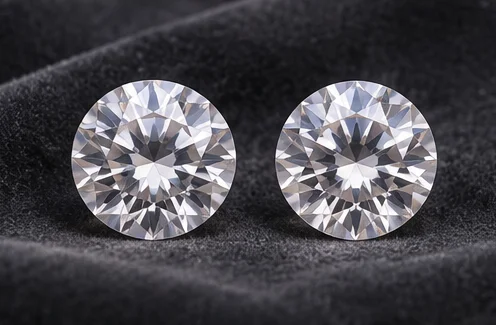
Updated November 2026
Quick answer: Lab-created white sapphire is real corundum (aluminum oxide) grown in a lab. It has the same hardness (Mohs 9), refractive index and appearance as natural white sapphire, but it is usually flawless and costs about $25–$150 per carat versus $50–$1,500 for natural. Natural white sapphire is rarer, may show tiny inclusions or faint tints and holds value somewhat better. Only magnification or a gem lab can reliably tell them apart.
“Lab-created,” “lab-grown,” “created,” “synthetic” and “man-made” white sapphire all mean the same thing. This guide explains how lab sapphire is made, how it differs from natural white sapphire and which one suits your budget. For the basics, start with what is white sapphire.
Natural vs Lab-Created White Sapphire at a Glance
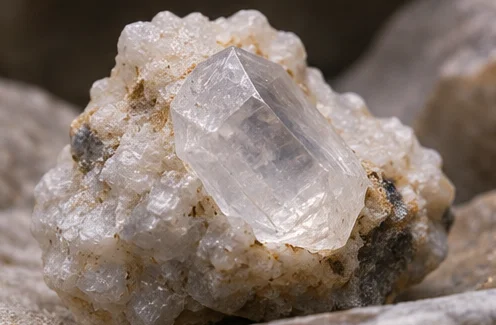
| Natural white sapphire | Lab-created white sapphire | |
|---|---|---|
| Composition | Corundum, Al₂O₃ | Corundum, Al₂O₃ |
| Mohs hardness | 9 | 9 |
| Refractive index | 1.762–1.770 | 1.762–1.770 |
| Formation | Millions of years in metamorphic or igneous rock | Hours to weeks in a furnace |
| Clarity | Often has silk, crystals or fingerprints | Usually flawless; may show gas bubbles or curved growth lines |
| Color | Colorless to faint gray, yellow or blue tint | Typically very white |
| Treatment | Usually heated | None needed |
| Price per carat | $50–$1,500+ | $25–$150 |
| Resale value | Low to moderate | Very low |
| Rarity | Natural, finite | Unlimited supply |
Is Lab-Created White Sapphire Real?
Yes. A lab-created white sapphire is genuine sapphire: the same mineral, chemistry and crystal structure as a natural stone. It is not a simulant like glass or cubic zirconia. The only difference is origin. Sellers must disclose that a stone is lab-created; in the United States, the FTC Jewelry Guides require a clear qualifier such as “lab-created,” “laboratory-grown,” “synthetic” or “created.” Our guide to natural vs lab-grown vs imitation gemstones explains these terms.
How Lab White Sapphire Is Made
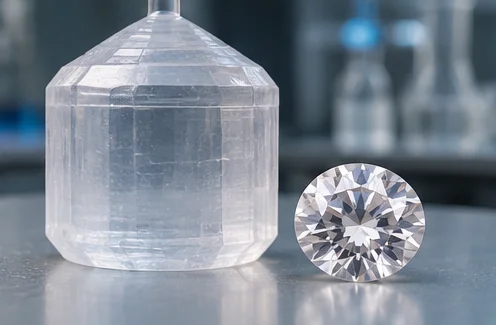
| Method | How it works | Notes |
|---|---|---|
| Verneuil (flame fusion) | Aluminum oxide powder is melted in a hydrogen-oxygen flame and builds up a pear-shaped “boule” | Invented by Auguste Verneuil in 1902; fastest and cheapest; may show curved growth lines and gas bubbles |
| Czochralski (pulling) | A seed crystal is slowly pulled from molten aluminum oxide | Very clean crystals; used for optics and jewelry |
| Kyropoulos | A large crystal grows slowly inside the melt | Produces huge boules for watch crystals and phone camera covers |
| Flux and hydrothermal | Crystals grow from a solvent or hot water solution over weeks | More natural-looking inclusions; more costly |
The same lab-grown sapphire crystals are used for scratch-resistant watch faces, smartphone camera lenses, LED substrates and scanner windows. The process applies to colored sapphires too; see natural vs lab-grown sapphire.
How to Tell Natural and Lab-Created White Sapphire Apart
You usually can’t by eye. Clues under 10x magnification or a microscope:
- Inclusions: natural stones often show fine rutile “silk,” tiny mineral crystals, fingerprints and straight, angular growth zoning. Lab stones are often perfectly clean.
- Gas bubbles and curved lines: round or elongated bubbles and curved growth striae point to Verneuil lab sapphire.
- Too perfect for the price: a flawless, bright-white 3-carat “natural” white sapphire for a few dollars is almost certainly lab-created.
- Lab testing: spectroscopy and trace-element analysis confirm origin. For valuable stones, insist on a report. See how to identify genuine sapphire.
Price and Value
Lab-created white sapphire usually costs $25–$150 per carat, while natural white sapphire costs $50–$1,500 per carat depending on quality. Lab sapphire has almost no resale value; natural stones have modest resale value, and fine unheated natural stones with reports hold value best. See full ranges in our white sapphire price guide.
Ethics and Sustainability
Lab-created white sapphire involves no mining and has a fully traceable origin, but crystal growth uses significant energy. Natural white sapphire is often mined by small-scale artisanal miners, especially in Sri Lanka and Madagascar, where gem mining supports local livelihoods. Buy natural stones from sellers who can tell you the country of origin.
Which Should You Buy?
| If you want… | Choose |
|---|---|
| The lowest price and a flawless white look | Lab-created white sapphire |
| A natural gemstone with character | Natural white sapphire |
| Some long-term value | Fine natural, ideally unheated with a report |
| Astrological use (Vedic) | Natural white sapphire (lab stones are generally not accepted) |
| Maximum sparkle on a budget | Consider moissanite or a lab-grown diamond |
Comparing white sapphire with diamond? Read white sapphire vs diamond.
FAQs
Is lab-created white sapphire fake?
No. It is real sapphire made in a lab, with the same chemistry and hardness as natural sapphire.
Does lab-created white sapphire get cloudy?
No. Like natural sapphire, it does not cloud internally; surface dirt can dull it and cleaning restores it.
Can a jeweler tell if a white sapphire is lab-created?
Sometimes, with magnification, from bubbles, curved growth lines or a lack of natural inclusions. A gem lab can confirm it.
Is lab white sapphire good for an engagement ring?
Yes. It is just as hard and durable as natural white sapphire and costs much less.
Stay tuned to Gems Tycoon for more gemstone guides.


