Updated November 2026
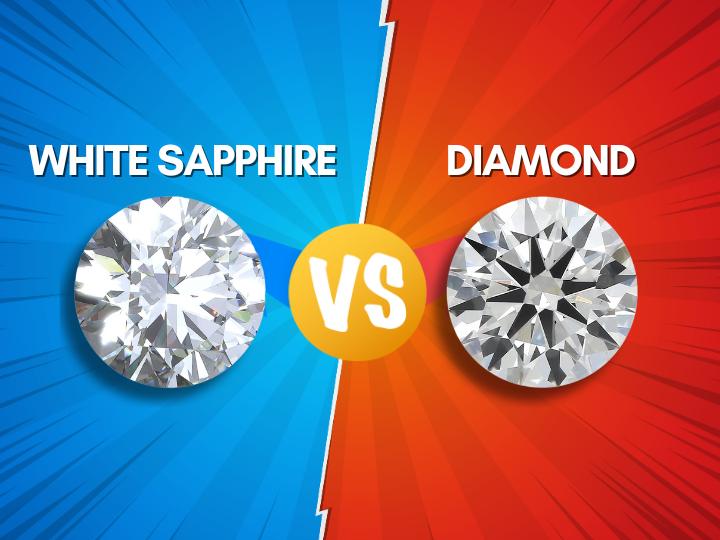
Quick answer: A diamond sparkles more, shows rainbow fire and resists scratches better (Mohs 10 vs 9). A white sapphire is a natural colorless corundum that costs a fraction of the price and is tougher against chipping, but it has a softer, silvery glow and needs more frequent cleaning. Choose diamond for maximum brilliance and long-term value; choose white sapphire for a larger natural stone on a smaller budget.
White sapphire and diamond are the two colorless gemstones people compare most often when shopping for engagement rings. From across a room they look alike. Up close, under a jeweler’s loupe, and after a few years of daily wear, they behave very differently.
This guide compares them on everything that affects your decision: chemistry, sparkle, hardness and toughness, 2026 prices (including lab-grown diamonds), treatments, how jewelers tell them apart, care and resale value. At the end you’ll find a simple “which one should you buy” table and answers to the most common questions.

Table of Contents
White Sapphire vs Diamond at a Glance
| Property | White Sapphire | Diamond |
|---|---|---|
| Mineral / composition | Corundum, aluminum oxide (Al₂O₃) | Crystallized carbon (C) |
| Crystal system | Trigonal | Cubic (isometric) |
| Hardness (Mohs) | 9 | 10, the hardest natural material |
| Toughness | Excellent, no cleavage | Good, but has cleavage planes that can chip |
| Refractive index | 1.76–1.77 | 2.42 |
| Dispersion (fire) | 0.018 | 0.044 |
| Refraction | Double refractive | Single refractive |
| Luster | Vitreous (glassy) | Adamantine (brilliant) |
| Specific gravity | ~4.00 (denser) | ~3.52 |
| Typical look | Silvery-white glow, little color flash | Bright white sparkle with rainbow flashes |
| Common treatments | Heat (routine); sometimes coating or glass filling | Natural stones usually untreated; some HPHT or fracture-filled |
| Diamond tester | Fails | Passes |
| Approx. 1 ct price (2026) | ~$150–$1,000 | Lab-grown ~$600–$1,500; natural ~$3,500–$6,000 |
| Grading system | No universal standard | GIA 4Cs (cut, color, clarity, carat), D–Z color |
| Resale value | Low | Natural: moderate; lab-grown: low |
| Birthstone | September | April |
| Best for | Natural stone, bigger size, smaller budget | Maximum sparkle, everyday durability, tradition |
What Is a White Sapphire?

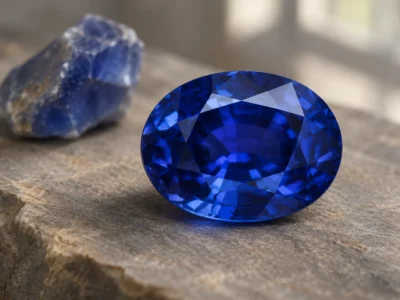
A white sapphire is colorless gem-quality corundum, the same mineral (aluminum oxide, Al₂O₃) that forms blue sapphire and ruby. Blue sapphire owes its color to traces of iron and titanium; ruby to chromium. A white sapphire is corundum with almost none of these trace elements, so it is colorless. Many stones still show a faint gray, blue or yellow tint.
White sapphire is not a diamond, and it is not a fake. It is a real, natural gemstone in its own right. When it is used to look like a diamond in jewelry, gemologists call it a diamond simulant.
Where white sapphires come from
The best-known source is Sri Lanka (Ceylon), especially the gem gravels around Ratnapura. Other sources include Madagascar, Myanmar (Burma), Thailand, Australia and Montana in the USA. Thailand is also the world’s main center for heat-treating sapphires.
Natural vs lab-created white sapphire
Lab-created white sapphire has the same chemistry, hardness and optical properties as natural white sapphire. It is grown by methods such as Verneuil flame fusion and the Kyropoulos and Czochralski methods. Lab sapphire is cleaner and whiter than most natural stones and costs far less, often under $100 per carat. Only a gemologist with magnification can usually tell them apart, so always ask the seller which one you are buying.
What Is a Diamond?
A diamond is pure carbon whose atoms are locked in a tight cubic crystal lattice, each atom bonded to four others. That structure makes diamond the hardest natural material and gives it exceptional brilliance and fire.
Natural diamonds formed 150–200 km deep in the Earth’s mantle and reached the surface through kimberlite pipes. Major producers include Botswana, Russia, Canada, South Africa and Australia. The largest gem diamond ever found is the 3,106-carat Cullinan diamond from South Africa.
How diamonds are graded: the 4Cs
The Gemological Institute of America (GIA) created the 4Cs used worldwide:
- Cut: how well the facets return light; the biggest factor in sparkle
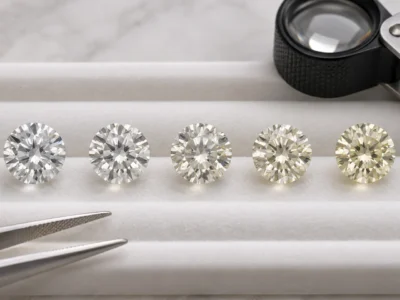
- Color: graded D (colorless) to Z (light yellow); D–F colorless, G–J near-colorless
- Clarity: from Flawless to Included; most buyers aim for “eye-clean” VS2–SI1
- Carat: weight, where 1 carat = 0.2 grams
White sapphire has no equivalent universal grading system, which is one reason its prices vary so much between sellers.
Natural vs lab-grown diamond
Lab-grown diamonds are real diamonds: chemically, physically and optically identical to mined ones. They are produced by CVD (chemical vapor deposition) or HPHT (high pressure, high temperature) and graded by labs such as GIA and IGI. The key difference today is price: lab-grown diamonds now cost roughly 80% less than comparable natural diamonds, which has changed the white sapphire vs diamond decision completely (see the price section below).
Appearance: Does White Sapphire Look Like a Diamond?
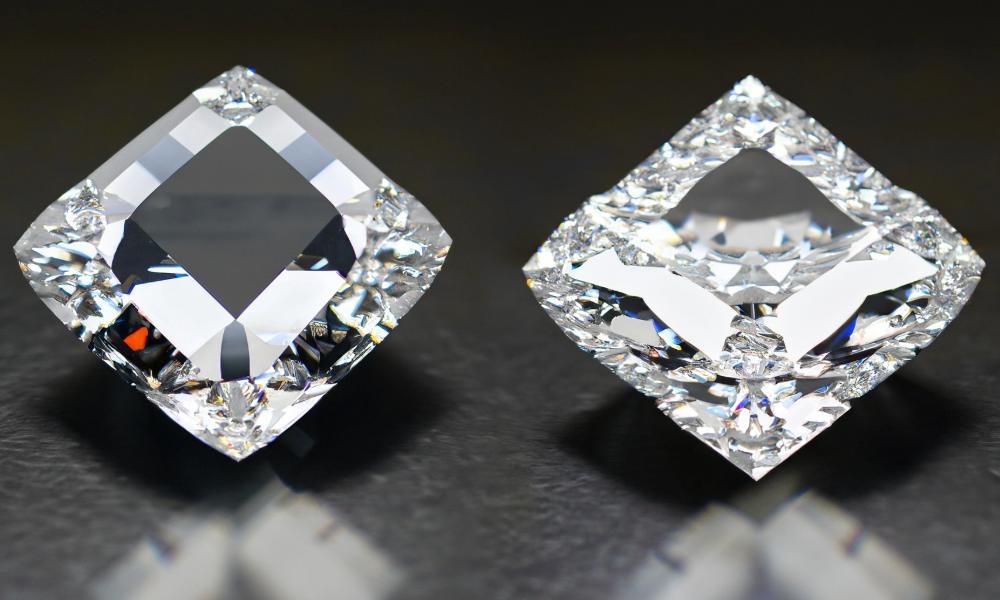
In small sizes (under 0.5 carat, as accent or side stones) most people can’t tell them apart. As the stone gets bigger, the differences become obvious, because diamond’s optics are in a different league. Four optical properties explain why.
Brilliance (refractive index)
Brilliance is the white light a stone returns to your eye. It depends on the refractive index (RI), which measures how strongly the stone bends light. Diamond’s RI is 2.42; white sapphire’s is about 1.77. A well-cut diamond traps light and sends it back out through the top in bright, sharp flashes. A white sapphire leaks more light out of its back, so it looks softer and can appear slightly glassy or milky.
Fire (dispersion)
Fire is the rainbow color you see when a stone splits white light into spectral colors. Diamond’s dispersion is 0.044, more than twice white sapphire’s 0.018. Diamonds throw visible red, blue and orange flashes, especially under spotlights. White sapphires show very little color; their sparkle stays silvery-white.
Luster and scintillation
Diamond has an adamantine luster, the brightest surface shine of any natural gem. White sapphire’s luster is vitreous, like good glass. Scintillation, the on-off sparkle as the stone moves, is also stronger in diamond because of its higher RI and razor-sharp facet edges.
Single vs double refraction
Diamond is singly refractive. White sapphire is doubly refractive (birefringence about 0.008): light splits into two rays inside the stone. Through a loupe you can sometimes see the back facet edges doubled in a sapphire. In a diamond they always look crisp and single.
Color and clarity
The best white sapphires are truly colorless, but many show faint gray, blue or yellow undertones, and some have a slight cloudiness (“silk”) that dulls their sparkle. Diamonds are graded precisely from D to Z, so you know exactly what color you are buying.
Size: why a 1-carat white sapphire looks smaller
White sapphire is denser than diamond (specific gravity about 4.00 vs 3.52), so the same weight takes up less space. A 1-carat round diamond measures about 6.5 mm across, while a 1-carat round white sapphire is closer to 6.0–6.2 mm. Compare stones by millimeter size, not carat weight.
How it changes over time
This is the difference most buyers overlook. White sapphire attracts skin oils, lotion and soap film, which coat the surface and dull its sparkle within days. Over years, its slightly softer facet edges can also wear and round off. A diamond stays brighter between cleanings and keeps its sharp facets for generations.
Durability: Hardness, Toughness and Cleavage
Both stones are durable enough for an everyday engagement ring. But “durable” covers three different properties, and each stone wins on a different one.
Hardness (scratch resistance)
On the Mohs scale, diamond is 10 and white sapphire is 9. The scale is not linear: diamond is roughly four times harder than sapphire in absolute terms. Household dust contains quartz (Mohs 7), which slowly scratches anything softer, so both stones resist everyday dust. Only diamond, moissanite or another sapphire can scratch a white sapphire. After years of wear a white sapphire may show fine scratches and slightly rounded facet edges, which a jeweler can re-polish. A diamond normally won’t.
Toughness (resistance to chipping)
Toughness is resistance to breaking or chipping from a knock, and here white sapphire has the edge. Corundum has no cleavage, so a hard knock is less likely to split it. Diamond has perfect cleavage in four directions: a sharp blow at the wrong angle, typically on a thin girdle or a pointed corner, can chip or split it despite its hardness.
| Risk | White Sapphire | Diamond |
|---|---|---|
| Fine surface scratches | Possible over years | Very rare |
| Rounded, dull facet edges | Possible over years | Very rare |
| Chipping from a hard knock | Less likely | Possible on points and thin girdles |
| Loss of sparkle from dirt | Fast | Slower |
To protect either stone, choose a bezel or halo setting and avoid exposed pointed shapes such as marquise or princess cuts in unprotected prongs. If you work with your hands, take the ring off for the gym, gardening and heavy work.
White Sapphire vs Diamond Price (2026)
A natural white sapphire costs a fraction of a natural diamond of the same size. But the comparison that matters most in 2026 is white sapphire vs lab-grown diamond, because lab-grown prices have fallen sharply. (Comparing a blue or colored sapphire instead? See our sapphire vs diamond price and rarity guide.)
| Carat (round) | Natural white sapphire | Lab-grown diamond (G/VS) | Natural diamond (G/VS) |
|---|---|---|---|
| 0.5 ct | $50–$300 | $200–$600 | $1,000–$2,000 |
| 1.0 ct | $150–$1,000 | $600–$1,500 | $3,500–$6,000 |
| 1.5 ct | $300–$2,000 | $1,000–$2,500 | $8,000–$14,000 |
| 2.0 ct | $500–$3,000 | $1,500–$3,500 | $15,000–$25,000 |
Why white sapphire costs less than diamond
- Supply and rarity: colorless corundum is relatively common, and lab sapphire is cheap to grow.
- No standard grading: there is no 4Cs-style system or major brand demand to support white sapphire prices.
- Marketing and tradition: a century of diamond advertising built the diamond engagement ring tradition and the premium that comes with it.
- Price per carat rises with size: large natural diamonds are exponentially rarer, so a 2-carat diamond costs far more than twice a 1-carat one. White sapphire prices rise much more gently.
White sapphire vs lab-grown diamond: the 2026 reality
At 1 carat, a good lab-grown diamond now often costs about the same as a top-quality natural white sapphire, and gives you the full brilliance, fire and Mohs 10 hardness of diamond. If price was your main reason for choosing white sapphire, compare it against lab-grown diamond first.
White sapphire still makes sense if you want a natural, mined gemstone on a small budget, a very large stone (3 carats and up) at a low price, or a softer, understated look instead of diamond’s flashy fire.
White Sapphire Treatments to Know Before You Buy
Most white sapphires on the market are treated. Some treatments are permanent and accepted; others are not. Always ask the seller to disclose treatment in writing.
| Treatment | What it does | Permanent? | Verdict |
|---|---|---|---|
| Heat treatment | Removes tints and cloudiness, improves clarity | Yes | Standard and accepted in the trade |
| Surface coating | A thin film makes the stone look whiter | No, wears off with scratches | Avoid, or pay much less |
| Diffusion | Changes only the outer layer’s color | Can be lost if re-polished | Avoid for a center stone |
| Fracture / glass filling | Lead glass fills cracks to hide flaws | No, damaged by heat and chemicals | Avoid |
| None (unheated) | Natural, untreated stone | – | Rarest and most expensive |
Natural diamonds are usually untreated. Treated diamonds (HPHT color treatment, laser drilling, fracture filling) must be disclosed on a GIA or IGI report.
How to Tell a White Sapphire From a Diamond

Does white sapphire pass a diamond tester?
No. Standard diamond testers measure thermal conductivity: diamond conducts heat extremely well and white sapphire does not, so it fails. Moissanite also conducts heat well and can fool a basic thermal tester, so jewelers use multi-testers that also check electrical conductivity.
Simple checks anyone can try
- Look for rainbow fire. Under a spotlight or sunlight, diamond flashes red and blue. White sapphire stays mostly white-silver.
- The fog test. Breathe on the stone. Diamond disperses heat so fast the fog clears almost instantly; on a white sapphire it lingers a second or two longer. Treat this as a hint, not proof.
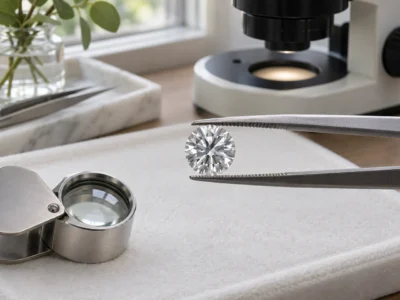
- Check the facet edges. Through a 10x loupe, diamond’s edges are razor-sharp. On a worn white sapphire they may look slightly rounded or nicked.
- Look for doubled back facets. White sapphire’s double refraction can make the back facet edges look doubled at certain angles. Diamond never does.
- Check the paperwork. A diamond of any real size should come with a GIA or IGI grading report, often with a matching laser inscription on the girdle.
For a definite answer, ask a qualified gemologist to test the stone with a refractometer or spectroscope.
Care and Cleaning
White sapphire needs cleaning more often than diamond to keep its sparkle. Plan on a quick clean every one to two weeks.
- At home (both stones): soak in warm water with a few drops of mild dish soap for 15–20 minutes, scrub gently behind the stone with a soft toothbrush, rinse and dry with a lint-free cloth.
- Ultrasonic and steam cleaners: generally safe for untreated or heat-treated white sapphire and untreated diamonds. Never use them on coated, fracture-filled or glass-filled stones.
- Avoid: chlorine, bleach and harsh household cleaners, and wearing the ring while applying lotion.
- Professional check: have prongs checked once a year. A white sapphire that has dulled after many years can be re-polished by a jeweler.
White Sapphire vs Diamond Engagement Rings

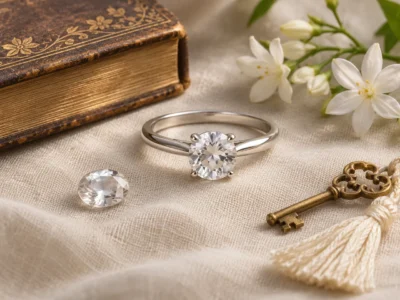
A diamond is the traditional choice and the safest bet for a ring worn every day for decades. A white sapphire engagement ring is a good choice if you:
- want a natural gemstone with a softer, more understated glow
- want a larger center stone than your budget allows in diamond
- like vintage, Art Deco or minimalist designs where subtle sparkle suits the style
- are buying a placeholder ring you may upgrade later
Setting tips
- A halo of small diamonds around a white sapphire center adds brilliance, though it can also highlight the difference in sparkle.
- A bezel setting protects the edges best.
- White gold or platinum keeps the stone looking whiter; yellow gold can warm up a stone with faint undertones.
- Oval, round and cushion shapes hide white sapphire’s lower brilliance better than step cuts like emerald or Asscher.
White Sapphire vs Diamond vs Moissanite vs Cubic Zirconia
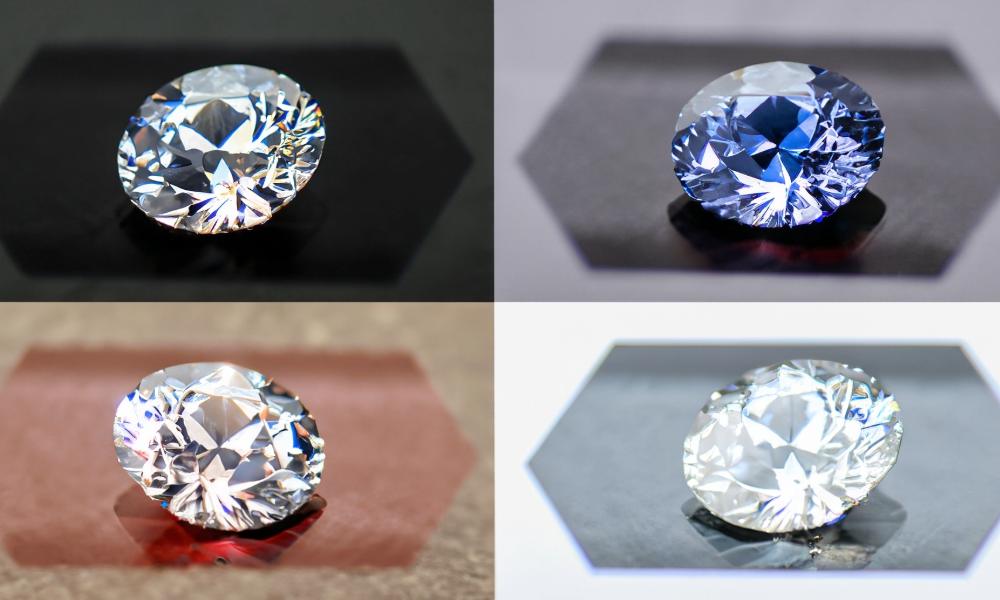
| White Sapphire | Diamond | Moissanite | Cubic Zirconia | |
|---|---|---|---|---|
| Material | Corundum (Al₂O₃) | Carbon | Silicon carbide (SiC) | Zirconium dioxide (ZrO₂) |
| Natural? | Yes (or lab-made) | Yes (or lab-grown) | Almost always lab-made | Always lab-made |
| Mohs hardness | 9 | 10 | 9.25 | 8–8.5 |
| Refractive index | 1.77 | 2.42 | 2.65–2.69 | 2.15–2.18 |
| Fire (dispersion) | 0.018 (low) | 0.044 | 0.104 (very high) | ~0.060 |
| Approx. 1 ct price | $150–$1,000 | $600–$6,000 | $300–$600 | Under $50 |
| Passes diamond tester | No | Yes | Often (thermal) | No |
| Long-term look | Dulls without cleaning | Stays bright | Stays bright | Scratches and clouds over time |
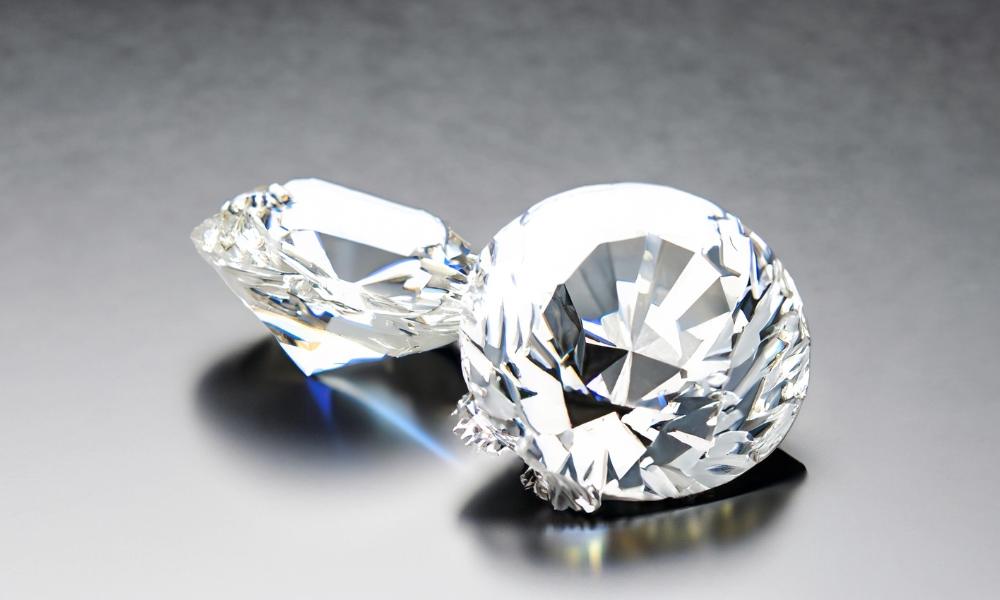
If you want the most sparkle for the least money, moissanite outperforms white sapphire: next to it, white sapphire can look grayish. If you want a natural gemstone, white sapphire is the only option in this table besides diamond. For a deeper look, see our moissanite vs white sapphire and moissanite vs diamond guides.
Ethics, Value and Symbolism
Ethics and sourcing
The Kimberley Process certification scheme, launched in 2003, aims to keep conflict diamonds out of the rough diamond trade. It does not cover colored gemstones, including sapphire. For either stone, ask the seller about the country of origin and any mine-to-market traceability. Lab-grown diamonds and lab-created sapphires avoid mining altogether, though their production uses significant energy.
Value and resale
Neither stone is a reliable investment. Natural diamonds have an established resale market, but you will usually get back only a fraction of the retail price. Lab-grown diamonds have very little resale value because their prices keep falling. White sapphire has low resale value too; buy it because you love it, not to store wealth.
Symbolism and tradition
Sapphire is the September birthstone (see how blue sapphire compares in sapphire vs diamond) and the traditional gift for a 45th anniversary; diamond is the April birthstone and marks the 60th. Sapphire has long been linked with wisdom and loyalty, diamond with strength and eternal love. In Vedic astrology (Jyotish), white sapphire is often recommended as a more affordable substitute for diamond as a stone of the planet Venus (Shukra); consult an astrologer if that is part of your decision.
Which Should You Choose?
| If you want… | Choose |
|---|---|
| The most brilliance and fire | Diamond (natural or lab-grown) |
| The best scratch resistance for daily wear | Diamond |
| A large stone on a tight budget | Lab-grown diamond or white sapphire |
| A natural, mined gemstone for under $1,000 | White sapphire |
| A soft, understated, vintage look | White sapphire |
| Better resistance to chipping | White sapphire |
| Long-term resale value | Natural diamond |
| Minimal upkeep | Diamond |
Bottom line: if sparkle and low maintenance matter most, buy a diamond, and look at lab-grown first if budget is tight. If you want a natural gemstone with a gentle glow and a lower price, a well-cut, eye-clean, heat-treated (not coated or filled) white sapphire is a beautiful, durable choice.
Related White Sapphire and Diamond Guides
- What is white sapphire?
- White sapphire price per carat (2026)
- Natural vs lab-created white sapphire
- White sapphire vs cubic zirconia
- White topaz vs white sapphire
- Raw white sapphire and white sapphire meaning and astrology
- Best diamond alternatives compared
- Cubic zirconia vs diamond and how to tell if a diamond is real
- Diamond color and clarity chart
White Sapphire vs Diamond FAQs
Is white sapphire a real diamond?
No. White sapphire is colorless corundum (aluminum oxide); diamond is crystallized carbon. They are different minerals with different hardness, optics and value. White sapphire is a real gemstone, but not a diamond.
Does white sapphire look like a diamond?
From a distance and in small sizes, yes. Up close, a diamond shows brighter white sparkle and rainbow fire, while white sapphire has a softer, silvery glow. The difference becomes clearer in stones over about 1 carat.
Can a jeweler tell the difference between white sapphire and diamond?
Yes, immediately. A jeweler can see it with a loupe and confirm it with a diamond tester, which white sapphire fails.
Does white sapphire sparkle like a diamond?
Not quite. White sapphire’s refractive index (1.77) and dispersion (0.018) are much lower than diamond’s (2.42 and 0.044), so it shows less brilliance and very little fire.
Does white sapphire get cloudy over time?
The stone itself doesn’t change (see does white sapphire get cloudy), but oils and dirt build up on its surface quickly and make it look cloudy. Regular cleaning restores it. Coated white sapphires can look duller as the coating wears.
How long does a white sapphire last?
A lifetime. At Mohs 9 with excellent toughness, a white sapphire can be worn daily for decades. After many years it may need a professional re-polish to restore sharp facets.
Is white sapphire good for an everyday engagement ring?
Yes. It is the second-hardest natural gemstone and less prone to chipping than diamond. Expect to clean it more often, and choose a protective setting.
White sapphire vs lab-grown diamond: which is better?
For sparkle and scratch resistance, lab-grown diamond, and at 1 carat the two often cost about the same in 2026. Choose white sapphire if you specifically want a natural, mined stone or a very large stone at the lowest price.
Is white sapphire worth it?
Yes, if you value a natural gemstone, a larger size for your budget and an understated look, and you don’t mind regular cleaning. If maximum brilliance or resale value matters most, a diamond is the better buy.
Is white sapphire cheaper than diamond?
Yes. A natural 1-carat white sapphire costs roughly $150–$1,000, compared with about $600–$1,500 for a lab-grown diamond and $3,500–$6,000 for a good-quality natural diamond.
Stay tuned to Gems Tycoon for more gemstone guides.