Updated November 2026
Quick answer: Moissanite is lab-created silicon carbide; diamond is pure carbon. Moissanite is slightly less hard (Mohs 9.25 vs 10), has a higher refractive index (2.65–2.69 vs 2.42) and more than twice the fire (0.104 vs 0.044), so it shows more rainbow sparkle. A good 1-carat-size moissanite costs about $300–$600, compared with roughly $600–$1,500 for a lab-grown diamond and $3,500–$6,000 for a natural diamond. Choose diamond for classic white brilliance, grading and resale; choose moissanite for maximum sparkle and size on a budget.
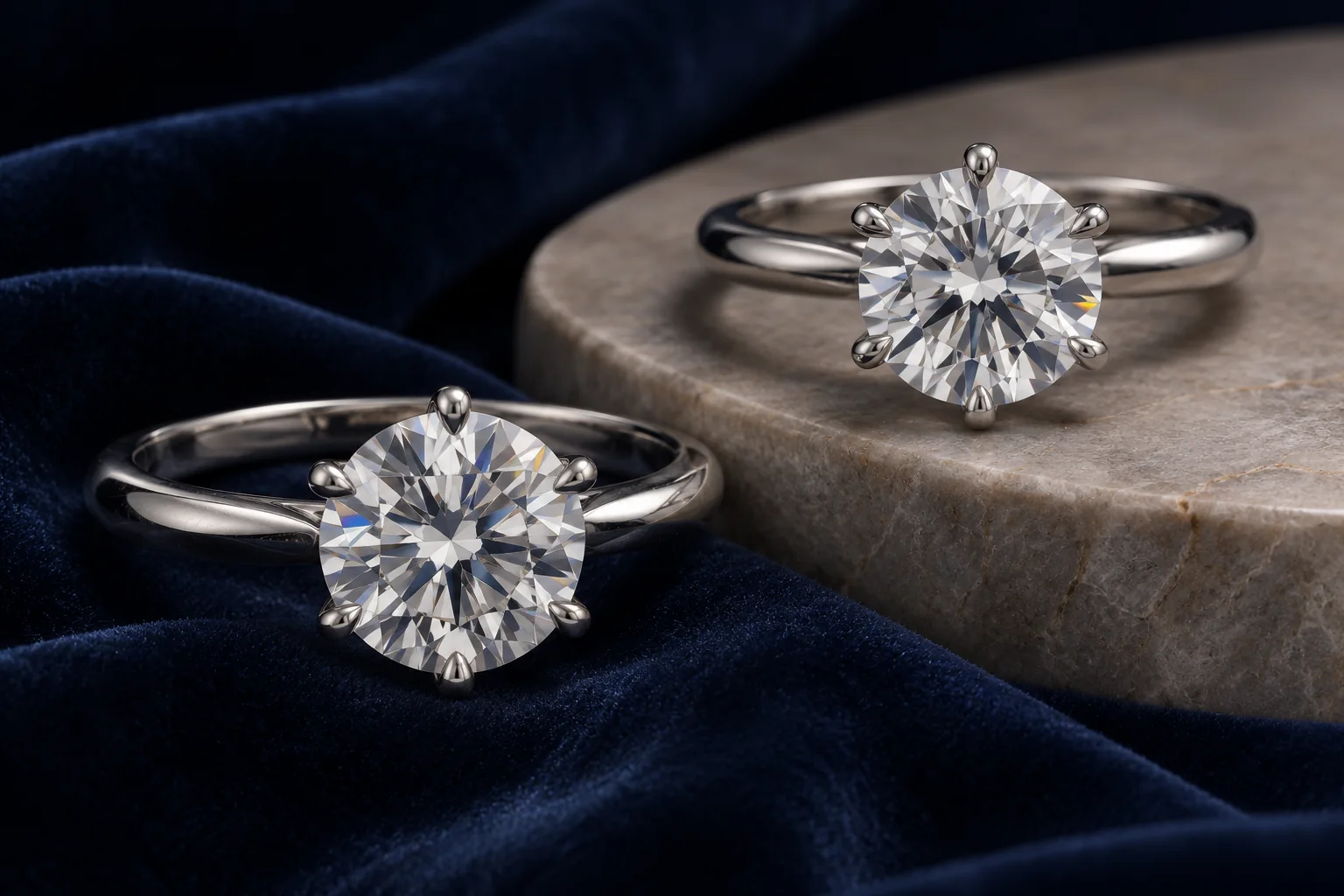
Moissanite is the most popular diamond alternative for engagement rings. At a glance the two stones look alike, but they differ in chemistry, optics, grading, price and long-term value. This guide compares them on every factor that matters, side by side. New to the stone? Start with what is moissanite.
Table of Contents
Moissanite vs Diamond vs Lab-Grown Diamond: Side by Side
| Property | Moissanite | Natural diamond | Lab-grown diamond |
|---|---|---|---|
| Composition | Silicon carbide (SiC) | Carbon (C) | Carbon (C) |
| Origin | Lab-created | Mined; formed deep in the Earth’s mantle | Lab-grown (CVD or HPHT) |
| Mohs hardness | 9.25 | 10 | 10 |
| Toughness | Very good, no cleavage | Good, has cleavage planes | Good, has cleavage planes |
| Refractive index | 2.65–2.69 | 2.417–2.419 | 2.417–2.419 |
| Dispersion (fire) | 0.104 | 0.044 | 0.044 |
| Refraction | Double refractive | Single refractive | Single refractive |
| Specific gravity | ~3.22 (about 10% lighter) | 3.52 | 3.52 |
| Color | Colorless (D–F) or near-colorless (G–I) seller grades; also fancy colors | D–Z on the GIA scale; rare fancy colors | D–Z; colored stones widely available |
| Grading | Seller grades; not graded by GIA | GIA, AGS or IGI reports on the 4Cs | GIA or IGI reports |
| Thermal conductivity | High | Very high | Very high |
| Electrical conductivity | Yes (semiconductor) | No (most) | No (most) |
| Approx. price, 1 ct size | $300–$600 | $3,500–$6,000 | $600–$1,500 |
| Resale value | Very low | Moderate | Low |
| Symbolism | Modern, practical | Tradition, permanence, heirloom | Modern, eco-conscious |
Is Moissanite a Diamond?
No. Moissanite is a different mineral. In 1893 the French chemist Henri Moissan found tiny crystals in the Canyon Diablo meteorite in Arizona and first thought they were diamonds; in 1904 he identified them as silicon carbide. Natural moissanite was later found in Earth’s upper mantle, in rocks near Wyoming, but only in microscopic grains. All jewelry moissanite is lab-created, and Charles & Colvard brought the first gem moissanite to market in 1998. After the original patents expired, many other manufacturers began producing it.
When moissanite is used in place of diamond, gemologists call it a diamond simulant. That is different from a lab-grown diamond, which is real diamond made in a lab. See natural vs lab-grown vs imitation gemstones for how these terms work.
Brilliance, Fire and Scintillation
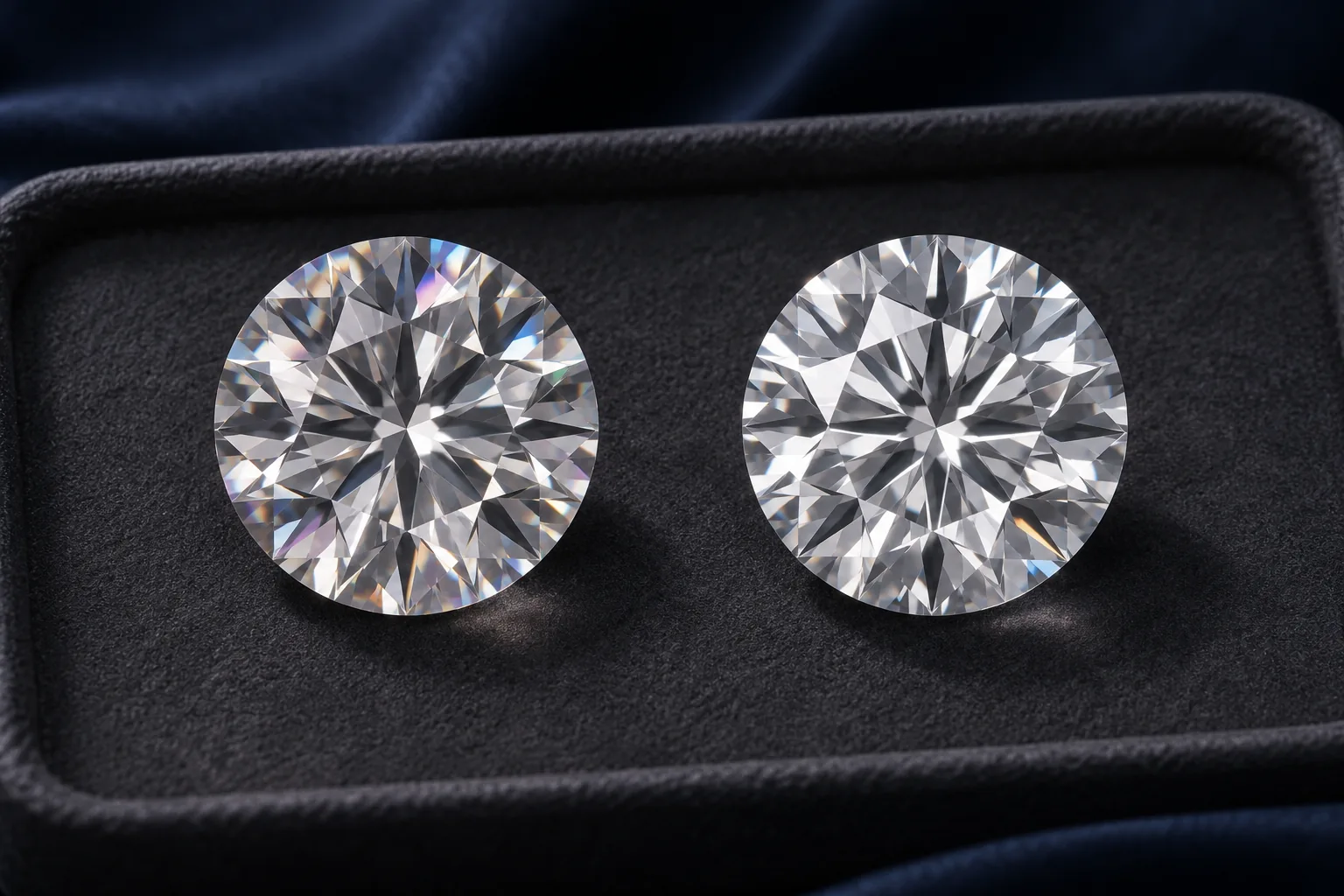
Sparkle has three parts: brilliance (white light returned to the eye), fire (rainbow flashes from dispersion) and scintillation (the on-off flashes as the stone moves).
- Brilliance: moissanite’s refractive index (2.65–2.69) is higher than diamond’s (2.42), so it is slightly more brilliant.
- Fire: moissanite’s dispersion (0.104) is about 2.4 times diamond’s (0.044). It throws many more rainbow flashes, sometimes called the “disco ball” or “rainbow effect”.
- Scintillation pattern: a well-cut diamond shows crisp, defined flashes of white and color. Moissanite’s pattern can look busier and softer because of its double refraction.
The difference grows with size: moissanite’s extra fire is most noticeable in stones over 1 carat and in bright sunlight or spotlights. In small stones and in pavé or halo accents, most people cannot tell them apart.
Color
Diamonds are graded on the GIA color scale from D (colorless) to Z (light yellow or brown). Colorless diamonds (D–F) cost the most; near-colorless (G–J) offer the best value. Nitrogen causes yellow tints and boron creates blue diamonds.
Moissanite color has improved a lot. Early “classic” moissanite looked yellowish or greenish, similar to a J–M diamond. Charles & Colvard’s later lines moved to near-colorless (Forever Brilliant, roughly G–I) and then colorless (Forever One, launched in 2015 and sold as D–F). Today most brands offer colorless and near-colorless grades, but these are the seller’s grades, not independent GIA grades. Moissanite also comes in gray, black, green, yellow and teal.
Tip: in white gold or platinum, choose D–F moissanite. Yellow or rose gold can hide a slight tint in near-colorless stones.
Clarity
Natural diamonds form under extreme heat and pressure, so most contain inclusions. GIA clarity runs from Flawless (FL) through VVS, VS and SI to Included (I). Many buyers choose an eye-clean VS2 or SI1 diamond to save money.
Moissanite is grown under controlled conditions, so it is almost always eye-clean, usually VVS or VS. Sellers use diamond-style clarity terms, but GIA and AGS do not grade moissanite.
Cut and Shape
Both stones come in every popular shape: round brilliant, oval, cushion, pear, princess, radiant, emerald, marquise and Asscher, plus antique cuts. The round brilliant is the most popular for both. Diamonds receive a GIA cut grade (Excellent to Poor) on round stones; moissanite cut quality is described by the seller, with premium and “hearts and arrows” options.
Because moissanite is doubly refractive, cutters orient the table perpendicular to the crystal’s optic axis so the doubling isn’t visible from the top. Brilliant cuts such as round, oval and cushion show moissanite at its best. Step cuts such as emerald and Asscher reveal more of the doubling and rainbow effect.
Hardness, Toughness and Durability
On the Mohs hardness scale, diamond is 10 and moissanite is 9.25, the second-hardest gem material. Only diamond and moissanite can scratch moissanite, so both shrug off everyday dust (quartz, Mohs 7).
| Material | Mohs hardness |
|---|---|
| Diamond (natural and lab-grown) | 10 |
| Moissanite | 9.25 |
| Sapphire and white sapphire | 9 |
| Cubic zirconia | 8–8.5 |
| Emerald | 7.5–8 |
| Quartz (household dust) | 7 |
Toughness is a different property: resistance to chipping and breaking. Diamond has cleavage planes, so a hard knock at the wrong angle can chip it, especially on pointed shapes such as princess and marquise or on a thin girdle. Moissanite has no cleavage, so it is less likely to chip. Both are durable enough for a ring worn every day, and both are stable to heat and do not cloud or discolor.
Moissanite vs Diamond Price and Size
Price is the biggest difference. Diamonds are priced on the 4Cs and their price per carat rises steeply with size. Moissanite is priced mainly by millimeter size, color grade, cut and brand, and its price rises roughly in line with size. Because moissanite is about 10% lighter than diamond, sellers describe it in millimeters or DEW (diamond equivalent weight): a 6.5 mm round moissanite looks like a 1-carat diamond.
| Size (round) | Moissanite | Lab-grown diamond (G/VS) | Natural diamond (G/VS) |
|---|---|---|---|
| 5.2 mm (0.5 ct) | $50–$250 | $200–$600 | $1,000–$2,000 |
| 6.5 mm (1 ct) | $300–$600 | $600–$1,500 | $3,500–$6,000 |
| 8.0 mm (2 ct) | $500–$1,000 | $1,500–$3,500 | $15,000–$25,000 |
| 9.3 mm (3 ct) | $700–$1,500 | $3,000–$7,000 | $30,000+ |
Put another way: for the price of an eye-clean, colorless natural diamond of around 0.8 carat (about 6 mm), you can buy a colorless moissanite more than 1 cm across. That size advantage is the main reason couples choose moissanite. To understand why diamonds cost so much, read why are diamonds so expensive.
Moissanite vs Lab-Grown Diamond
Lab-grown diamonds changed this comparison. They are real diamonds, chemically and optically identical to mined diamonds, with the same hardness of 10. They are graded by GIA or IGI and now cost roughly 80% less than natural diamonds. A lab-grown diamond still costs about two to three times more than a moissanite of the same size.
- Choose lab-grown diamond if you want the true diamond look and hardness, an independent grading report and a lower price than natural.
- Choose moissanite if you want the lowest price, the most fire and the biggest stone for your budget.
How to Tell Moissanite From Diamond
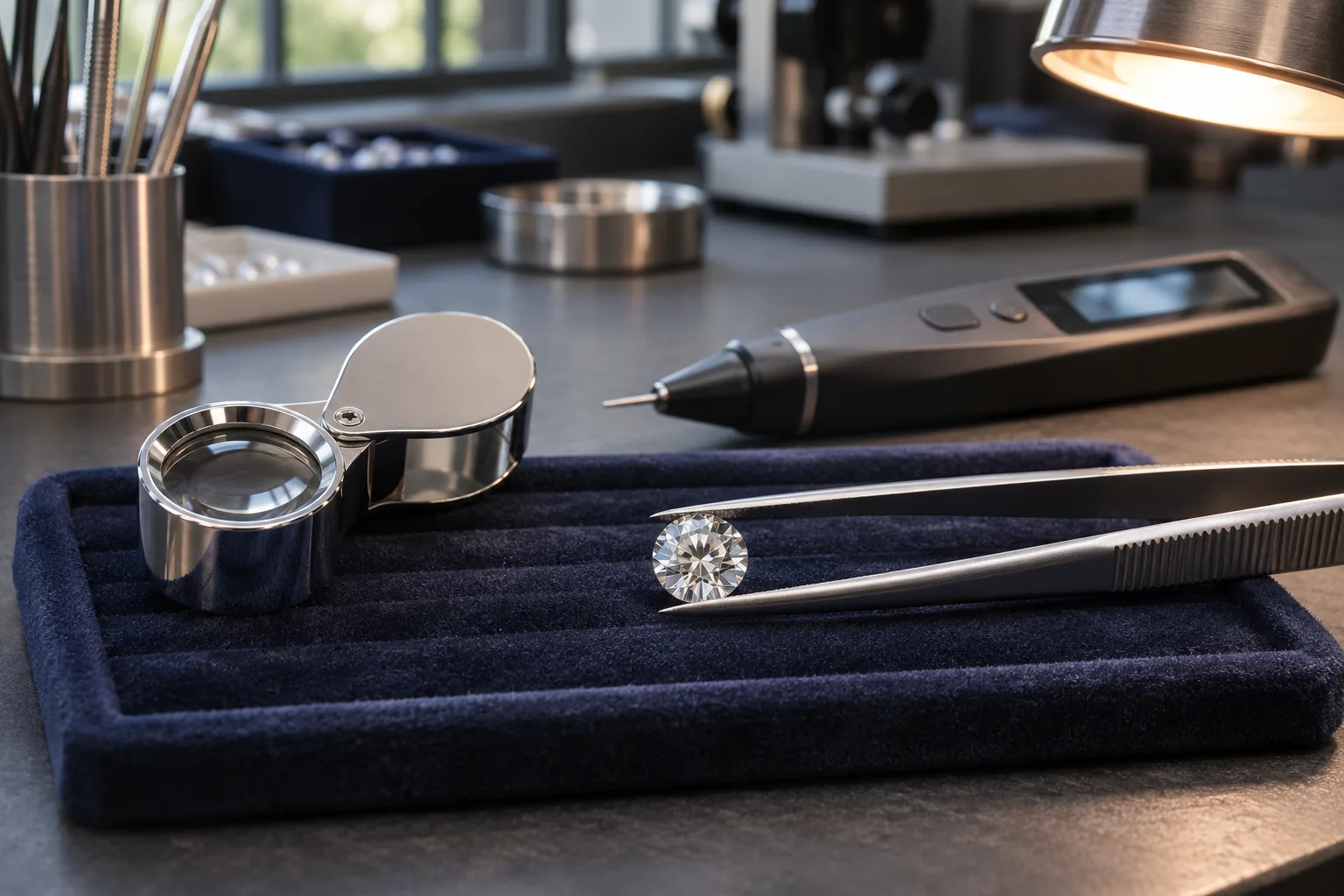
- Use the right tester. Both stones are excellent thermal conductors, so moissanite can pass a basic thermal diamond tester. A moissanite tester or multi-tester also measures electrical conductivity, which identifies moissanite.
- Look for doubled facets. Through a 10x loupe, view the stone from the side. Doubled facet junctions mean moissanite; diamond is singly refractive and never shows doubling.
- Compare the fire. Side by side in sunlight or under spotlights, moissanite shows noticeably more rainbow color, especially over 1 carat.
- Check the documents and inscription. A diamond should have a GIA, AGS or IGI report whose number matches the laser inscription on the girdle.
Watch for fraud. GIA has reported synthetic moissanite with fake laser inscriptions designed to pass as diamond, and the trade press has reported moissanite coated with a thin diamond film. Buy from reputable sellers and verify any report number online. Our guide to reading gemstone lab reports explains how.
Value, Resale and Heirloom Appeal
Natural diamonds have an established resale market and carry strong heirloom and traditional value, though you will usually get back far less than you paid. Lab-grown diamonds have little resale value because their prices keep falling. Moissanite has almost no resale value. If resale matters to you, natural diamond is the only one of the three with a real secondary market; if it doesn’t, moissanite gives you the most stone for your money.
Ethics and Sustainability
Moissanite is grown in labs, so it involves no mining and has a smaller environmental footprint than mined stones, though its production uses significant energy. Natural diamonds are mined; the Kimberley Process aims to keep conflict diamonds out of the rough trade, and many buyers also ask for country-of-origin traceability. Lab-grown diamonds also avoid mining.
Moissanite or Diamond Engagement Ring: Which Should You Choose?
| If you want… | Choose |
|---|---|
| Classic white diamond sparkle | Natural or lab-grown diamond |
| Maximum fire and rainbow sparkle | Moissanite |
| The biggest stone for your budget | Moissanite |
| An independent grading report | Natural or lab-grown diamond |
| The hardest stone | Diamond |
| Best chip resistance | Moissanite |
| Resale and heirloom value | Natural diamond |
| No mining | Moissanite or lab-grown diamond |
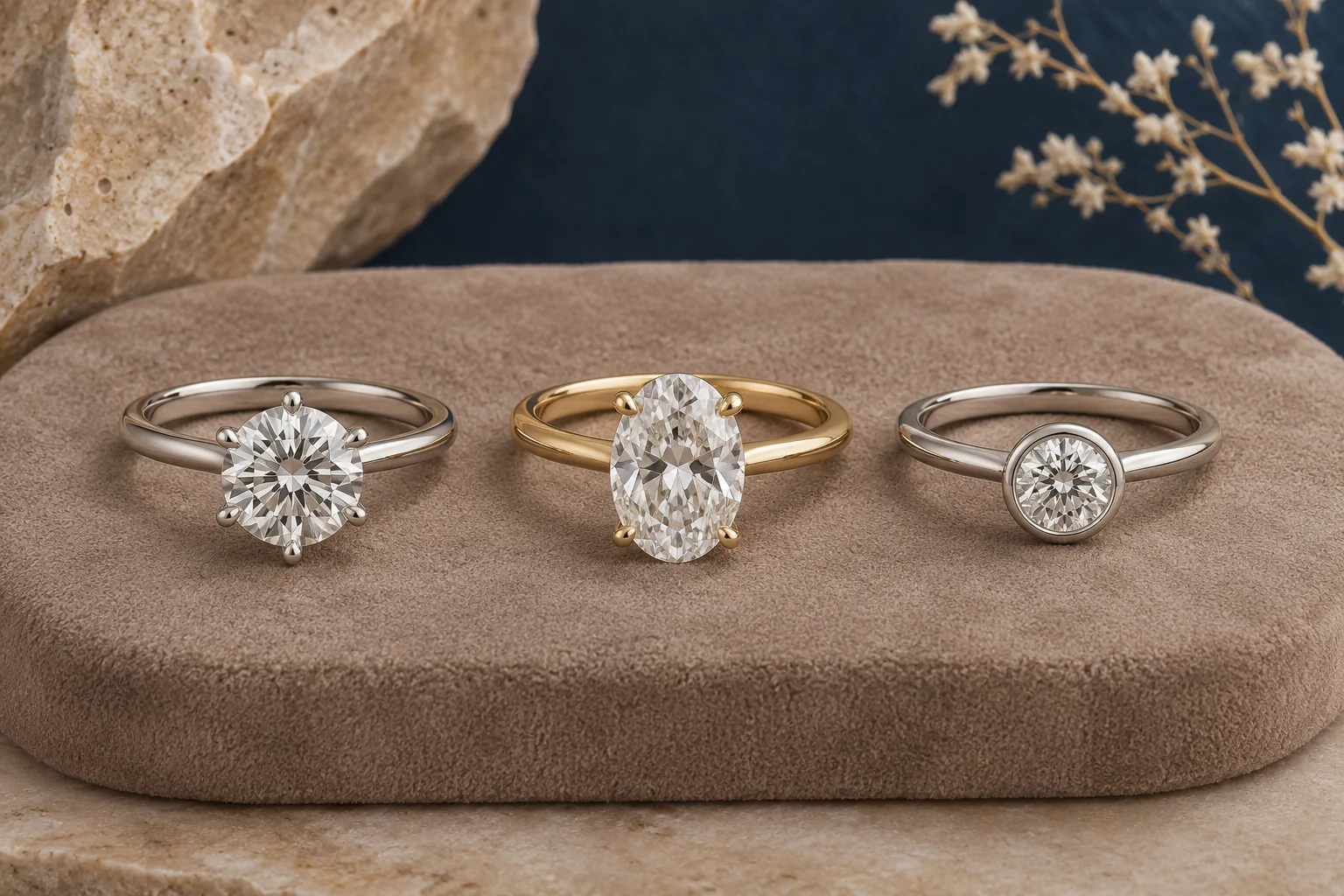
Setting tips: moissanite looks most diamond-like in a solitaire or halo setting in platinum or white gold, in round, oval or cushion shapes. Diamond pavé or a diamond halo around a moissanite center adds classic sparkle. A bezel or split-shank design adds protection for pointed shapes.
Other Diamond Alternatives
- White sapphire: a natural gemstone (Mohs 9) with a softer, silvery glow. Compare in white sapphire vs diamond and moissanite vs white sapphire.
- Blue and colored sapphire: for color instead of sparkle. See sapphire vs diamond.
- Cubic zirconia: very cheap (Mohs 8–8.5) but scratches and clouds over time. See zircon vs cubic zirconia.
Moissanite vs Diamond FAQs
Is moissanite better than diamond?
It depends on what you value. Moissanite has more fire and costs far less; diamond is harder, has classic white brilliance, independent grading and resale value.
Can people tell moissanite from diamond?
Most people can’t at a glance, especially under 1 carat. Jewelers can tell with a loupe (doubled facets) or a moissanite tester, and the extra rainbow fire can give it away in bright light.
Does moissanite pass a diamond tester?
It can pass a basic thermal tester because both stones conduct heat well. A moissanite tester or multi-tester that checks electrical conductivity will identify it.
Does moissanite get cloudy?
No. Moissanite doesn’t cloud or discolor with age. Oils and dirt on the surface can dull any stone, and a simple clean restores the sparkle.
Does moissanite last as long as diamond?
Yes. At Mohs 9.25 with no cleavage, moissanite lasts a lifetime in everyday jewelry, especially in a secure platinum or gold setting.
How much cheaper is moissanite than diamond?
A 1-carat-size moissanite costs about $300–$600, roughly 85–95% less than a comparable natural diamond and about half to a third of a lab-grown diamond.
Is moissanite a fake diamond?
Moissanite is a real gemstone in its own right, not glass or plastic. It is a diamond simulant when used in place of diamond, and it should always be sold as moissanite.
Where does moissanite come from?
Natural moissanite was discovered in a meteorite at Canyon Diablo, Arizona, in 1893, but it only occurs in microscopic grains. All jewelry moissanite is lab-created. Learn more in what is moissanite.
Stay tuned to Gems Tycoon for more gemstone guides.