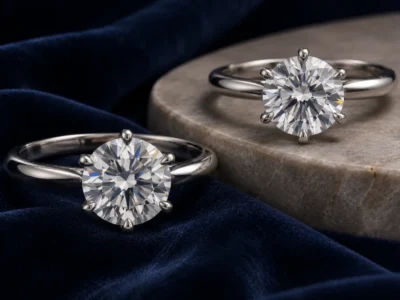
Updated November 2026
Quick answer: White sapphire is a natural (or lab-created) gemstone made of corundum, Mohs 9, with a soft silvery sparkle that lasts a lifetime. Cubic zirconia (CZ) is an inexpensive man-made material, zirconium dioxide, Mohs 8–8.5, with more fire and brightness at first but it scratches, abrades and looks cloudy within a few years of daily wear. Choose white sapphire for an engagement ring or heirloom; choose CZ for fashion jewelry or a temporary placeholder.
White sapphire and cubic zirconia are both used as diamond alternatives, but they are very different materials. Here is how they compare. New to white sapphire? Read what is white sapphire.
White Sapphire vs Cubic Zirconia at a Glance
| White sapphire | Cubic zirconia (CZ) | |
|---|---|---|
| Material | Corundum, aluminum oxide (Al₂O₃) | Zirconium dioxide (ZrO₂), stabilized with yttrium or calcium oxide |
| Origin | Natural or lab-created | Always man-made (no gem-quality natural equivalent) |
| Mohs hardness | 9 | 8–8.5 |
| Refractive index | 1.76–1.77 | 2.15–2.18 |
| Dispersion (fire) | 0.018 (low) | 0.058–0.066 (higher than diamond) |
| Refraction | Double | Single |
| Specific gravity | ~4.0 | 5.6–6.0 (very heavy) |
| Look when new | Soft, silvery-white glow | Bright with strong colored flashes |
| Look after years | Same, with cleaning | Scratched, rounded facets, cloudy |
| Price, 1 ct size | $150–$1,000 natural; $25–$150 lab | Under $50, often a few dollars |
| Resale value | Low to moderate | None |
What Is Cubic Zirconia?
Cubic zirconia is a synthetic crystal of zirconium dioxide, stabilized in a cubic structure with yttrium or calcium oxide. It was developed for jewelry in the 1970s by scientists in the Soviet Union using a “skull melting” process and quickly became the most popular diamond imitation because it is cheap and bright. Don’t confuse it with zircon, a natural gemstone with a similar name; see zircon vs cubic zirconia.
Sparkle and Appearance
When new, CZ is the flashier stone. Its refractive index (2.15–2.18) and dispersion (about 0.06) give it more brilliance and more rainbow fire than white sapphire, and even more fire than diamond. Some people find this looks “too perfect” or glassy-bright. White sapphire has a softer, silvery, understated sparkle with little color, which some buyers prefer as more natural and elegant.
CZ is usually flawless and perfectly white. Natural white sapphire may show a faint tint or tiny inclusions; lab-created white sapphire is also flawless.
Hardness and Durability Over Time
This is the biggest difference. At Mohs 9, white sapphire is only scratched by diamond, moissanite and other corundum, and it has excellent toughness. CZ, at Mohs 8–8.5, is softer and more brittle. With daily wear, CZ facet edges abrade and round off, the surface picks up fine scratches, and it collects a film of oils that is hard to remove, so it starts to look cloudy, often within two to three years. White sapphire can look as good after 30 years as on day one if it is cleaned regularly. Learn more about wear in does white sapphire get cloudy.
Weight and Size
CZ is about 50% heavier than white sapphire and about 70% heavier than diamond. A 6.5 mm round CZ, which looks like a 1-carat diamond, weighs about 1.6–1.7 carats. Always compare by millimeter size, not carat weight.
Price and Value
CZ costs very little: loose stones are often a few dollars, and a CZ ring costs mainly the price of the metal. Natural white sapphire costs about $50–$1,500 per carat; lab-created white sapphire about $25–$150. CZ has no resale value; white sapphire has modest value. See our white sapphire price guide.
How to Tell White Sapphire From Cubic Zirconia
- Fire: CZ shows obvious rainbow flashes; white sapphire shows little color.
- Weight: a CZ feels noticeably heavy for its size.
- Wear: rounded, scratched facet edges suggest CZ.
- Doubling: under a loupe, white sapphire may show doubled back facets; CZ never does.
- Testing: a refractometer, SG test or gem lab will confirm. Both fail a diamond tester.
For general tips, see how to tell if a gemstone is real.
Which Should You Choose?
| If you want… | Choose |
|---|---|
| An engagement or everyday ring that lasts | White sapphire |
| A natural gemstone | Natural white sapphire |
| The lowest possible price | Cubic zirconia |
| Fashion or travel jewelry | Cubic zirconia |
| Lots of fire on a small budget, long-lasting | Moissanite |
Considering diamond instead? Compare white sapphire vs diamond and cubic zirconia vs diamond.
FAQs
Is white sapphire better than cubic zirconia?
For long-term wear, yes. White sapphire is harder, tougher and keeps its look for decades; CZ scratches and clouds within a few years.
Does cubic zirconia sparkle more than white sapphire?
Yes, when new. CZ has a higher refractive index and more fire, but it loses sparkle as it wears.
Is cubic zirconia a real gemstone?
It is a real man-made crystal but not a natural gemstone and not a diamond. It is a diamond simulant.
Which is cheaper, white sapphire or cubic zirconia?
Cubic zirconia is much cheaper, often a few dollars per stone.
Stay tuned to Gems Tycoon for more gemstone guides.