
Updated November 2026
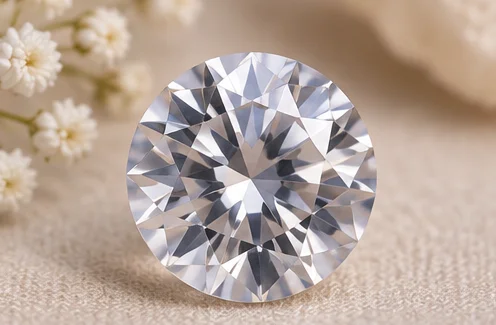
Quick answer: White sapphire is colorless gem-quality corundum: aluminum oxide (Al₂O₃) with almost no trace elements. It is the same mineral as blue sapphire and ruby, minus the color. White sapphire is a natural gemstone, the second-hardest after diamond (Mohs 9), with a soft, silvery sparkle and a price far below diamond. It is also called clear sapphire or colorless sapphire.
White sapphire is best known as a natural, affordable alternative to diamond. This guide explains exactly what it is, how it forms, its properties, treatments, value and uses, so you can judge it on its own merits. For a head-to-head comparison, see white sapphire vs diamond.
White Sapphire at a Glance
| Property | White sapphire |
|---|---|
| Mineral | Corundum |
| Chemistry | Aluminum oxide (Al₂O₃) |
| Crystal system | Trigonal (hexagonal crystals) |
| Mohs hardness | 9 |
| Toughness | Excellent; no cleavage |
| Refractive index | 1.762–1.770 |
| Birefringence | 0.008–0.010 (doubly refractive) |
| Dispersion | 0.018 |
| Specific gravity | 3.99–4.01 |
| Luster | Vitreous to subadamantine |
| Main sources | Sri Lanka, Madagascar, Myanmar, Thailand, Australia, Tanzania, Montana (USA) |
| Birthstone | September (sapphire) |
| Typical price | ~$50–$1,500 per carat (natural) |
What Is White Sapphire Made Of?
Sapphire is the gem variety of the mineral corundum, crystallized aluminum oxide. Pure corundum is colorless. Trace elements create every other color: iron and titanium make blue sapphire, chromium makes ruby and pink sapphire, and iron alone makes yellow and green. A white sapphire is corundum with so few trace elements that it shows no obvious color. Many stones still carry a faint gray, blue, yellow or brown tint, and the most valuable are completely colorless.
Because ruby and sapphire are the same mineral, white sapphire shares their durability and the “precious stone” status of the corundum family. Explore all the colors in our sapphire colors guide.
White, Clear or Colorless Sapphire?
They are the same stone. “White sapphire” is the trade name; gemologists prefer “colorless sapphire” because the stone is transparent, not white. You may also see “clear sapphire” or the older term “leuco-sapphire” (from the Greek for white). When a white sapphire is used in place of a diamond, it is called a diamond simulant, but it is a genuine natural gem in its own right.
Where Does White Sapphire Come From?
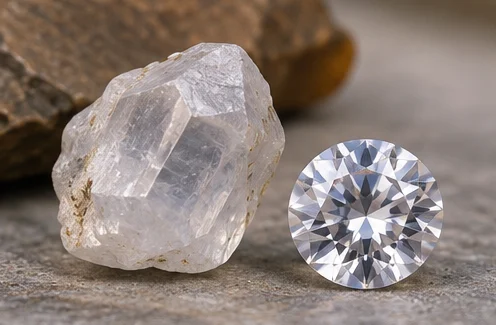
Sapphire forms in metamorphic rocks such as marble and gneiss and in some igneous rocks, then weathers out into gem gravels. The most important source of white sapphire is Sri Lanka (Ceylon), particularly the gem gravels around Ratnapura. Other sources include Madagascar, Myanmar (Burma), Thailand, Cambodia, Australia, Tanzania and Montana in the United States. Thailand, especially Chanthaburi, is the world center for cutting and heat-treating sapphire.
Rough white sapphire is often grayish or milky and is cut to bring out maximum brilliance. See raw white sapphire for how the rough looks and is identified.
Properties: Hardness, Sparkle and Durability
Hardness and toughness
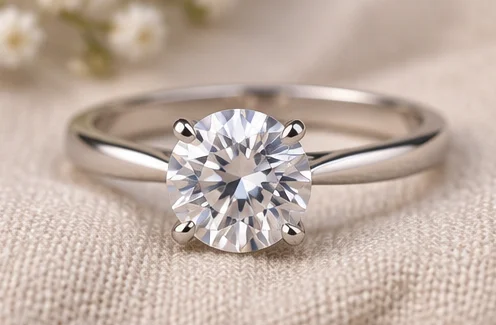
At 9 on the Mohs scale, white sapphire is the second-hardest natural gemstone after diamond and is only scratched by diamond, moissanite and other corundum. It has excellent toughness and no cleavage, so it is less likely to chip than diamond. This makes it a practical stone for rings worn every day. See where it sits on our Mohs hardness chart.
Sparkle
White sapphire’s refractive index (about 1.77) and dispersion (0.018) are much lower than diamond’s (2.42 and 0.044). The result is a softer, glassier, silvery-white sparkle with very little rainbow fire. Well-cut stones are bright and lively; poorly cut stones can look gray or “windowed” because light leaks out of the back.
Double refraction and weight
Sapphire is doubly refractive, so facet edges may look slightly doubled under a loupe. It is also denser than diamond: a 1-carat round white sapphire measures about 6.0–6.2 mm, compared with about 6.5 mm for a 1-carat diamond.
Does it stay bright?
White sapphire does not change color or cloud internally, but its surface attracts oils and dirt faster than diamond, which dulls the sparkle. Regular cleaning keeps it bright; see does white sapphire get cloudy.
How White Sapphire Quality Is Judged
There is no universal grading system like the diamond 4Cs, but dealers use the same factors:
- Color: the closer to completely colorless, the better. Faint gray, yellow or blue tints lower value.
- Clarity: look for an eye-clean stone. Fine needle-like “silk” can make the stone look hazy or milky.
- Cut: the most important factor for beauty. Precision cuts with good proportions maximize brilliance.
- Carat and size: clean, colorless stones over 2 carats are much rarer.
- Origin and treatment: unheated Sri Lankan stones with a lab report command a premium.
Treatments
| Treatment | Effect | Acceptable? |
|---|---|---|
| Heat | Removes tints and silk, improves clarity; permanent | Yes, standard in the trade |
| Surface coating | Makes the stone look whiter; wears off | Avoid |
| Diffusion | Alters color of the outer layer only | Avoid for center stones |
| Glass (fracture) filling | Hides cracks; damaged by heat and chemicals | Avoid |
Always ask for treatments to be disclosed in writing. Our genuine sapphire identification guide explains how labs detect them.
Is White Sapphire Valuable?
White sapphire is a precious natural gem but is far less expensive than diamond or fine blue sapphire. Most natural white sapphires sell for about $50–$1,500 per carat depending on color, clarity, cut, size and treatment; lab-created white sapphire often costs under $100 per carat. Resale value is modest, so buy it for its beauty and durability rather than as an investment. Full details are in our white sapphire price guide.
Uses Beyond Jewelry
Lab-grown colorless sapphire is one of the most useful industrial crystals. Because it is extremely hard and transparent, it is used for scratch-resistant watch crystals, smartphone camera lens covers, barcode scanner windows, optical components and as a substrate for LEDs. Synthetic sapphire has been made since the Verneuil flame-fusion process was introduced in the early 1900s. Learn more in natural vs lab-created white sapphire.
White Sapphire vs Diamond and Other White Stones
| Stone | Mohs | Sparkle | 1 ct price |
|---|---|---|---|
| White sapphire | 9 | Soft, silvery | $150–$1,000 |
| Diamond (natural) | 10 | Bright white with fire | $3,500–$6,000 |
| Lab-grown diamond | 10 | Same as diamond | $600–$1,500 |
| Moissanite | 9.25 | Strong rainbow fire | $300–$600 |
| White topaz | 8 | Glassy | Under $100 |
| Cubic zirconia | 8–8.5 | Bright at first, clouds over time | Under $50 |
Compare them in detail: white sapphire vs diamond, moissanite vs white sapphire, white sapphire vs cubic zirconia, white topaz vs white sapphire and lab-grown diamonds.
White Sapphire FAQs
Is white sapphire a real gemstone?
Yes. Natural white sapphire is a genuine gemstone, colorless corundum. Lab-created white sapphire has the same chemistry and properties but is made in a lab.
Is white sapphire a diamond?
No. White sapphire is aluminum oxide; diamond is carbon. They look similar but differ in hardness, sparkle and price.
What is the difference between white sapphire and clear sapphire?
There is none. White, clear and colorless sapphire all describe the same stone.
Is white sapphire good for everyday wear?
Yes. At Mohs 9 with excellent toughness, it suits engagement rings and daily jewelry, though it needs more frequent cleaning than diamond.
What does white sapphire symbolize?
Sapphire traditionally represents wisdom, loyalty and clarity, and it is the September birthstone. See white sapphire meaning and benefits.
Stay tuned to Gems Tycoon for more gemstone guides.


