Updated November 2026
Quick answer: Moissanite is a gemstone made of silicon carbide (SiC). It was discovered in 1893 in a meteorite crater, but natural moissanite is so rare that almost all moissanite jewelry is lab-created. It is a real gemstone, not a diamond and not a fake diamond. Moissanite is very hard (9.25 on the Mohs scale), shows more fire than diamond, and costs a fraction of the price: about $300–$600 for a good 1-carat stone.
Moissanite has become one of the most popular diamond alternatives for engagement rings. This guide explains exactly what moissanite is, where it comes from, how it is made, its properties, what it costs and how it compares with diamond, white sapphire and cubic zirconia.
Table of Contents
Moissanite at a Glance
| Property | Moissanite |
|---|---|
| Chemical composition | Silicon carbide (SiC) |
| Origin of gems | Almost always lab-created; natural crystals are microscopic |
| Discovered | 1893, by Henri Moissan, in the Canyon Diablo meteorite (Arizona) |
| Hardness (Mohs) | 9.25, harder than sapphire, softer than diamond |
| Refractive index | 2.65–2.69 (diamond: 2.42) |
| Dispersion (fire) | 0.104, about 2.4 times diamond’s 0.044 |
| Refraction | Double refractive (birefringence ~0.043) |
| Specific gravity | ~3.22, lighter than diamond (3.52) |
| Color grades | Colorless (D–F) and near-colorless (G–I); also colored varieties |
| Typical price, 1 ct (DEW) | ~$300–$600 for good quality; budget stones from ~$100 |
| Diamond tester | Often passes a basic thermal tester; fails a multi-tester |
| Resale value | Very low |
Where Does Moissanite Come From?
In 1893 the French chemist Henri Moissan, later a Nobel Prize winner, found tiny sparkling crystals in fragments of the Canyon Diablo meteorite at Meteor Crater, Arizona. He first thought they were diamonds. In 1904 he identified them as silicon carbide, and the mineral was named moissanite in his honor.
Natural moissanite has since been found as microscopic grains in meteorites and as tiny inclusions in some kimberlite and other rocks. No natural crystal has ever been large enough to cut into a jewelry stone. That is why every moissanite you can buy is lab-created.
How Is Moissanite Made?
Silicon carbide has been made industrially since the 1890s as an abrasive (carborundum). Growing large, clear, single crystals for gems took a century longer. In the 1990s, technology developed for semiconductors made it possible to grow gem-quality silicon carbide, and moissanite jewelry reached the market in 1998.
Today crystals are grown in high-temperature furnaces by seeded sublimation: silicon carbide powder is vaporized above 2,000°C and slowly deposits onto a seed crystal. The process takes weeks or months. The rough crystal is then cut and polished like any other gem, usually by skilled cutters because moissanite is very hard.
Is Moissanite Real or Fake?
Moissanite is a real gemstone with its own chemistry and crystal structure. It is not a diamond, and it is not a “fake diamond” in the way glass or cubic zirconia imitations are. Gemologists call it a diamond simulant when it is used in place of diamond, and a synthetic (lab-created) moissanite because it is made in a lab. Selling moissanite as diamond would be fraud, but selling it honestly as moissanite is entirely legitimate. Learn more about these terms in our guide to natural vs lab-grown vs imitation gemstones.
Moissanite Properties: Hardness, Sparkle and Color
Hardness and durability
At 9.25 on the Mohs scale, moissanite is harder than every natural gem except diamond. It resists scratches from everyday dust (quartz, Mohs 7), has good toughness and is stable to heat, so it suits an engagement ring worn every day. See where it sits on our Mohs hardness scale chart.
Brilliance and fire
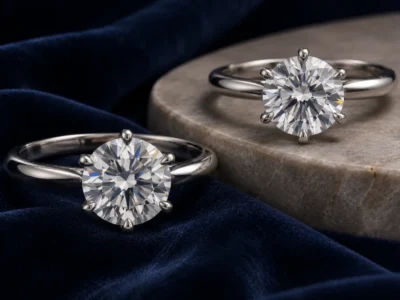
Moissanite has a higher refractive index than diamond (2.65–2.69 vs 2.42), so it returns a lot of light. Its dispersion of 0.104 is about 2.4 times diamond’s, which creates strong rainbow flashes, often called a “disco ball” or “rainbow” effect. Some people love it; others find it looks less like a diamond, especially in stones over 2 carats and in bright sunlight.
Double refraction
Moissanite is doubly refractive. Light splits into two rays inside it, so under a loupe the back facet edges can look doubled, or slightly fuzzy, when viewed at an angle. Cutters orient the stone to minimize this when viewed through the top. Diamond is singly refractive and never shows doubling.
Color and clarity
Early moissanite from the late 1990s and 2000s often had a yellow or green tint. Modern moissanite is sold as colorless (D–F) or near-colorless (G–I), using diamond-style letters, though these are seller grades, not GIA diamond grades. Lab-made stones are usually very clean, typically VVS or VS clarity. Moissanite also comes in colors such as gray, black, blue, green and yellow.
Weight and DEW
Moissanite is about 10% lighter than diamond. A 6.5 mm round moissanite looks like a 1-carat diamond but weighs only about 0.88 carat. Sellers therefore describe size in DEW (diamond equivalent weight). When you compare prices, compare millimeter size or DEW, not actual carat weight.
How Much Does Moissanite Cost?
Moissanite is priced mainly by size, cut quality, color grade and brand. Unlike diamond, its price rises roughly in line with size rather than exponentially.
| Size (DEW, round) | Moissanite (loose) | Lab-grown diamond | Natural diamond |
|---|---|---|---|
| 0.5 ct | $50–$250 | $200–$600 | $1,000–$2,000 |
| 1 ct | $100–$600 | $600–$1,500 | $3,500–$6,000 |
| 2 ct | $200–$1,000 | $1,500–$3,500 | $15,000–$25,000 |
| 3 ct | $300–$1,500 | $3,000–$7,000 | $30,000+ |
Moissanite vs Diamond, White Sapphire and Cubic Zirconia
| Moissanite | Diamond | White Sapphire | Cubic Zirconia | |
|---|---|---|---|---|
| Material | Silicon carbide | Carbon | Aluminum oxide (corundum) | Zirconium dioxide |
| Natural or lab | Lab-created | Natural or lab-grown | Natural or lab-created | Lab-made |
| Mohs hardness | 9.25 | 10 | 9 | 8–8.5 |
| Refractive index | 2.65–2.69 | 2.42 | 1.77 | 2.15–2.18 |
| Fire (dispersion) | 0.104 (very high) | 0.044 | 0.018 (low) | ~0.060 |
| Look | Bright, rainbow fire | Bright white with balanced fire | Soft, silvery glow | Bright at first, clouds and scratches over time |
| 1 ct price | ~$100–$600 | ~$600–$6,000 | ~$150–$1,000 | Under $50 |
| Lasts a lifetime? | Yes | Yes | Yes, with re-polishing | No |
For detailed head-to-head comparisons, see moissanite vs diamond, moissanite vs white sapphire, white sapphire vs diamond, sapphire vs diamond and zircon vs cubic zirconia.
How to Tell Moissanite From Diamond
- Use a multi-tester. Moissanite conducts heat almost as well as diamond, so it can pass a basic thermal diamond tester. A multi-tester also measures electrical conductivity, which identifies moissanite.
- Look for doubled facets. With a 10x loupe, look through the side of the stone. Doubled back facet edges point to moissanite.
- Watch the fire. Under a spotlight or sunlight, moissanite flashes much more rainbow color than diamond.
- Check the paperwork. Diamonds come with GIA or IGI reports. Moissanite usually comes with a seller certificate or warranty card, and branded stones may carry a laser inscription.
For a certain answer, have the stone tested by a jeweler or gemologist. Our guide on how to read a gemstone lab report explains what to look for.
Pros and Cons of Moissanite
| Pros | Cons |
|---|---|
| Costs about 85–95% less than a natural diamond | Very little resale value |
| Harder than any gem except diamond (9.25) | Strong rainbow fire can look less like diamond in large stones |
| More brilliance and fire than diamond | Double refraction visible under magnification |
| Does not cloud or discolor over time | Color and clarity grades are not standardized like GIA diamond grades |
| Lab-made, so no mining | Some people prefer a natural gemstone |
Buying and Caring for Moissanite
- Choose colorless (D–F) if you want the most diamond-like look, especially in white gold or platinum.
- Prioritize cut quality. A well-cut stone balances brilliance and fire; poorly cut stones can look glassy or overly rainbow.
- Compare by millimeter size or DEW, not actual carat weight.
- Ask for a warranty. Reputable sellers offer lifetime warranties on color and brilliance.
- Cleaning: warm water, mild soap and a soft brush. Moissanite is safe in ultrasonic and steam cleaners and does not get cloudy.
Moissanite FAQs
What is moissanite made of?
Silicon carbide (SiC), a compound of silicon and carbon. Diamond is pure carbon.
Is moissanite a real diamond?
No. Moissanite is a different gemstone. It looks similar to diamond and is used as a diamond alternative, but its chemistry and optical properties are different.
Is moissanite natural?
Natural moissanite exists but only as microscopic crystals, mainly in meteorites. All moissanite used in jewelry is lab-created.
Does moissanite pass a diamond tester?
It can pass a basic thermal diamond tester because it conducts heat well. A multi-tester that also checks electrical conductivity will identify it as moissanite.
Does moissanite get cloudy?
No. Moissanite does not cloud or change color. Like any gem, it can look dull when oils and dirt build up, and cleaning restores it.
How long does moissanite last?
A lifetime. At Mohs 9.25 with good toughness, moissanite is one of the most durable gemstones for everyday jewelry.
Is moissanite worth buying?
Yes, if you want a large, durable, sparkly stone at a low price and don’t need resale value. If you want a natural gemstone, consider white sapphire; if you want a true diamond at a lower price, consider lab-grown diamond.
Can people tell moissanite from diamond?
Most people cannot at a glance, especially in stones under 1.5 carats. Jewelers can tell with a loupe or multi-tester, and the extra rainbow fire can give it away in bright light. See our full moissanite vs diamond comparison.
Stay tuned to Gems Tycoon for more gemstone guides.