Updated November 2026
Quick answer: Diamonds are usually more expensive than sapphires. A good 1-carat natural diamond costs around $3,500–$6,000, while most good blue sapphires cost $1,000–$3,000 per carat. But the finest sapphires, such as unheated royal blue or Kashmir stones, can cost far more per carat than a diamond. Diamond is harder (Mohs 10 vs 9) and sparkles more; sapphire offers color, is tougher against chipping and gives you more size for the money.
Sapphire and diamond are the two most popular gemstones for engagement rings and fine jewelry. They are also the two hardest natural gems. This guide compares them on the questions buyers actually ask: price, rarity, hardness, appearance, value and which one suits your ring. If you are comparing a colorless sapphire with a diamond, see our dedicated white sapphire vs diamond guide.
Table of Contents
Sapphire vs Diamond at a Glance
| Property | Sapphire | Diamond |
|---|---|---|
| Mineral | Corundum, aluminum oxide (Al₂O₃) | Crystallized carbon (C) |
| Colors | Blue, plus pink, yellow, orange, green, purple, padparadscha, black and colorless (white) | Mostly colorless to light yellow; rare fancy colors |
| Hardness (Mohs) | 9 | 10 |
| Toughness | Excellent, no cleavage | Good, but can chip along cleavage planes |
| Refractive index | 1.76–1.77 | 2.42 |
| Dispersion (fire) | 0.018 | 0.044 |
| Specific gravity | ~4.00 | ~3.52 |
| Grading | Color first, then clarity, cut, carat, origin and treatment | GIA 4Cs: cut, color, clarity, carat |
| Typical price (good quality, 1 ct) | ~$1,000–$3,000 | ~$3,500–$6,000 natural; ~$600–$1,500 lab-grown |
| Birthstone | September | April |
| Anniversary | 45th | 60th |
Is Sapphire More Expensive Than Diamond?
Usually no. For the quality most people buy, a sapphire costs less than a diamond of the same weight. But sapphire prices span a much wider range than diamond prices, so the top sapphires are more expensive per carat than most diamonds.
| Stone | Approx. price per carat (USD) |
|---|---|
| Lab-created sapphire | $25–$400 |
| Natural white sapphire | $50–$1,500 |
| Commercial blue sapphire (light or included) | $200–$600 |
| Good blue sapphire (medium blue, eye-clean) | $1,000–$3,000 |
| Fine heated cornflower blue, 2 ct+ | $2,500–$5,500 |
| Unheated royal blue, 2 ct+ | $8,000–$18,000+ |
| Kashmir sapphire (fine) | $50,000+; record sales above $100,000 |
| Lab-grown diamond, 1 ct (G/VS) | ~$600–$1,500 |
| Natural diamond, 1 ct (G/VS) | ~$3,500–$6,000 |
| Natural diamond, 2 ct (G/VS) | ~$7,500–$12,500 per carat |
Why most sapphires are cheaper than diamonds
- Heat treatment is routine. Most sapphires are heated to improve color, which makes good-looking stones more plentiful and keeps prices down.
- Diamond demand is built-in. A century of marketing made the diamond the default engagement stone, which supports its price. Read more in why are diamonds so expensive.
- Standard grading. Diamonds are traded on the GIA 4Cs and price lists, so prices are consistent. Sapphire has no universal price grid, so ordinary stones sell at a discount.
When a sapphire costs more than a diamond
Look for these traits: an intense, even royal or cornflower blue; no heat treatment (confirmed by a lab report from GIA, SSEF, Gübelin or AGL); a prized origin such as Kashmir, Burma (Myanmar) or Sri Lanka (Ceylon); and a size over 3 carats. A stone with all of these can cost several times more per carat than a fine diamond. Rare colors such as padparadscha (pinkish orange) are also priced above most diamonds.
Is Sapphire Rarer Than Diamond?
Fine sapphires are rarer than fine diamonds. Corundum itself is a common mineral, but gem-quality crystals with strong, pure color, good clarity and large size are scarce. Gem diamonds are mined on an industrial scale, mainly in Botswana, Russia, Canada and South Africa, and are found in far greater quantity than top-color sapphires.
Ordinary sapphires and ordinary diamonds are both widely available. Among diamonds, the truly rare stones are fancy colors such as red, blue and pink, while a colorless diamond of average quality is not rare at all.
Sapphire vs Diamond Hardness and Durability
Diamond is the hardest natural material, rated 10 on the Mohs scale. Sapphire is 9, the second-hardest natural gemstone. The Mohs scale is not linear: diamond is about four times harder than sapphire, so only a diamond, moissanite or another sapphire can scratch a sapphire.
Are sapphires stronger than diamonds?
In one way, yes. Hardness is resistance to scratching; toughness is resistance to breaking. Sapphire has no cleavage, so it resists chipping from a knock better than diamond. Diamond has perfect cleavage in four directions, which means a hard blow at the wrong angle can chip a point or a thin girdle. Both are excellent for everyday rings. Choose a protective setting such as a bezel or halo for either stone.
| Durability | Sapphire | Diamond |
|---|---|---|
| Scratch resistance (hardness) | Excellent (9) | Best (10) |
| Chip resistance (toughness) | Excellent | Good |
| Stability to heat and light | Excellent | Excellent |
| Everyday ring wear | Yes | Yes |
Appearance: Color, Sparkle and Size
Color
Color is the biggest difference. A sapphire is chosen for its color, which comes from trace elements: iron and titanium create blue, chromium creates pink, and iron alone creates yellow and green. A diamond is chosen for its absence of color: the less yellow, the more valuable, graded from D (colorless) to Z. See our sapphire colors guide for every variety.
Sparkle
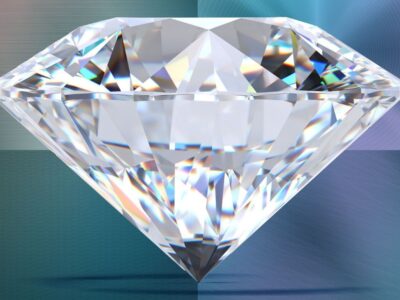
Diamond has a much higher refractive index (2.42 vs 1.77) and more than twice the dispersion (0.044 vs 0.018). That gives it bright white brilliance and rainbow fire. A sapphire shows a rich, glowing color with softer, glassy sparkle. In colored sapphires, depth of color matters far more than sparkle.
Size
Sapphire is denser than diamond (specific gravity about 4.00 vs 3.52), so a 1-carat sapphire looks slightly smaller than a 1-carat diamond. A 1-carat round diamond is about 6.5 mm across; a 1-carat round sapphire is about 6.0–6.2 mm. Compare stones by millimeters, not carats.
Sapphire vs Diamond Engagement Rings
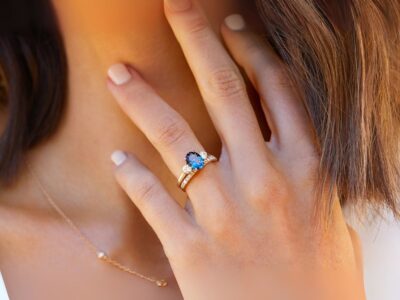
A diamond is the traditional engagement stone. A sapphire is the most popular colored alternative, made famous by the 12-carat oval Ceylon sapphire surrounded by diamonds that Princess Diana received in 1981 and that the Princess of Wales wears today.
- Choose diamond for maximum sparkle, the classic look and the widest choice of certified stones.
- Choose blue sapphire for a distinctive, royal look, better chip resistance and a lower price at most quality levels.
- Combine both: a sapphire center with a diamond halo or diamond side stones gives you color and sparkle together.
- Want a colorless stone? Compare white sapphire vs diamond, and see our white sapphire engagement ring ideas.
Natural vs Lab-Grown Sapphire and Diamond
Both stones are made in laboratories with the same chemistry and hardness as natural stones. Lab sapphire (made by flame fusion, Czochralski or Kyropoulos methods) has existed for over a century and is very cheap. Lab-grown diamonds (CVD or HPHT) are now about 80% cheaper than natural diamonds. A lab-grown diamond can cost less than a fine natural blue sapphire. Learn how to tell them apart in our natural vs lab-grown sapphire guide and how to identify genuine sapphire.
Value, Resale and Investment
Neither stone is a guaranteed investment, and both usually resell for well below retail. Natural diamonds have the most liquid resale market because of standard grading. Fine unheated sapphires from top origins with major lab reports have held value well at auction, but ordinary heated sapphires have limited resale value. Lab-grown diamonds and lab sapphires have very little resale value.
Meaning and Symbolism
Sapphire is the September birthstone and has long symbolized wisdom, loyalty and faithfulness. Diamond is the April birthstone and symbolizes strength and eternal love. In Vedic astrology, blue sapphire (Neelam) is linked with Saturn and diamond with Venus.
Sapphire or Diamond: Which Should You Choose?
| If you want… | Choose |
|---|---|
| Maximum sparkle and fire | Diamond |
| Color and a distinctive look | Sapphire |
| The best scratch resistance | Diamond |
| Better chip resistance | Sapphire |
| A bigger stone for the budget | Sapphire or lab-grown diamond |
| A rare collector’s gem | Unheated fine sapphire |
| Easiest resale | Natural diamond |
Bottom line: choose diamond for brilliance and tradition, and sapphire for color, character and value. If you can’t decide, a sapphire center stone with diamond accents gives you the best of both.
Sapphire vs Diamond FAQs
Are sapphires cheaper than diamonds?
Most are. A good blue sapphire costs about $1,000–$3,000 per carat, compared with roughly $3,500–$6,000 for a good 1-carat natural diamond. The finest unheated or Kashmir sapphires are the exception and can cost much more.
Are diamonds more expensive than sapphires?
At typical jewelry quality, yes. At the very top end, a fine unheated sapphire can cost more per carat than a fine diamond.
Is sapphire rarer than diamond?
Fine, richly colored sapphires are rarer than fine colorless diamonds. Ordinary sapphires and diamonds are both widely available.
Is sapphire harder than diamond?
No. Diamond is 10 on the Mohs scale and sapphire is 9. But sapphire is tougher, meaning it is less likely to chip.
Are sapphires heavier than diamonds?
Yes, by volume. Sapphire’s specific gravity is about 4.00 versus 3.52 for diamond, so a sapphire of the same size weighs more, and a sapphire of the same carat weight looks slightly smaller.
Is a sapphire as good as a diamond for an engagement ring?
Yes. Sapphire is hard and tough enough for daily wear and has been a royal engagement stone for decades. Choose it if you love color; choose diamond if you want maximum sparkle.
What is the difference between white sapphire and diamond?
White sapphire is colorless corundum with a softer, silvery sparkle and a much lower price; diamond is brighter and harder. Our white sapphire vs diamond guide covers it in detail, and moissanite vs white sapphire compares the other popular alternative.
Stay tuned to Gems Tycoon for more gemstone guides.