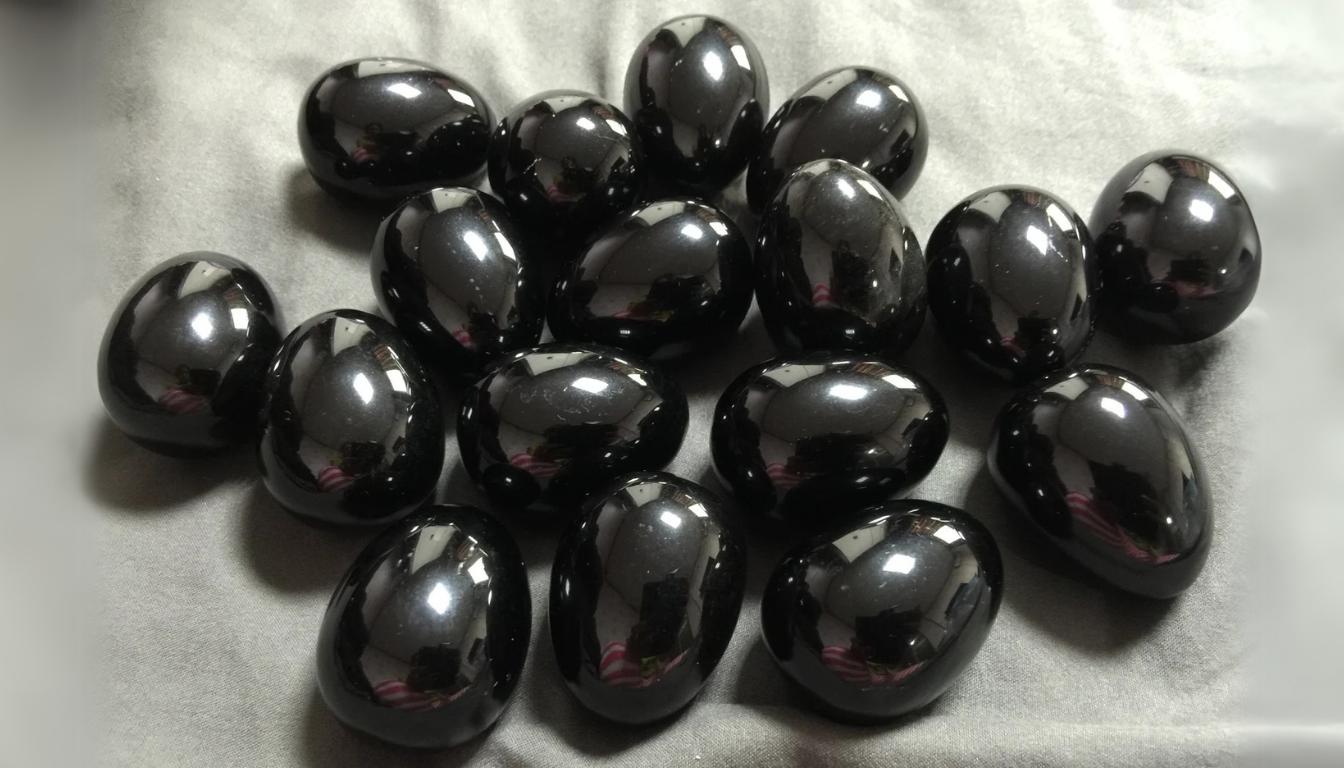
Black obsidian and black onyx may look similar as polished jewelry stones, but they have different geological origins. Obsidian is naturally occurring volcanic glass, whereas onyx is a variety of chalcedony within the quartz family. Names in online shops are sometimes used loosely, so verify the actual material.
How obsidian forms
Obsidian forms when silica-rich lava cools rapidly without developing a conventional crystalline structure. It is a natural glass, not a quartz crystal. Some specimens are nearly black, while others exhibit brownish, reddish or iridescent appearances due to inclusions or microscopic textures. The label ‘black crystal’ is a popular colloquialism, not a precise geological classification.
What onyx means in gemstone trading
Onyx traditionally refers to chalcedony with parallel banding, often black-and-white. Solid black ‘onyx’ in jewelry is frequently black chalcedony, sometimes dyed to achieve uniform color. Other unrelated rocks, including some carbonate materials, are also commercially named onyx; ‘onyx marble’ is not the same as quartz-family onyx. The exact mineral identification should be on a trustworthy sales description.
Compare hardness and fracture
Obsidian commonly has Mohs hardness roughly 5 to 5.5 and a glassy conchoidal fracture. Onyx as chalcedony generally has hardness around 6.5 to 7. Both may chip under impact, but the quartz-family material usually has greater resistance to everyday abrasion. Obsidian can produce very sharp edges when fractured, which is another reason not to perform destructive home scratch tests.
How appearance misleads buyers
Polished black surfaces and reflections can make both materials look nearly identical. Onyx may reveal banding and obsidian may show glassy luster, but not every polished piece clearly exposes diagnostic clues. Glass, resin and dyed stone may also be sold under similar descriptive names. Color alone does not prove identity or natural origin.
Treatment and authenticity questions
Black chalcedony may be artificially colored; onyx and obsidian imitations also exist. Dyeing does not automatically mean a natural chalcedony item is fake, but it must be disclosed when known. Ask for a mineral species identification, whether color is natural, and whether the item has coatings or repairs. Professional testing is more reliable than solvent, heat or scratch experiments.
Choosing and caring for jewelry
Either material may suit pendants or beads that avoid frequent hard impact. An exposed daily ring is more vulnerable to damage, particularly with obsidian. Store separately from harder stones, use gentle cleaning appropriate to treatments, and protect polished surfaces from scratches. Neither material has clinically established powers to treat stress or disease.
Frequently asked questions
Can a phone photograph establish a gem’s identity?
No. Visual appearance alone cannot determine composition, origin or treatments.
Should I rely on seller labels alone?
For a high-value purchase, consider credible independent identification and accurate written disclosures.
Do gemstone meanings have proven medical effects?
No. Traditional symbolism can be culturally important without establishing a clinical treatment.
Related reading
Sources
General consumer education, not a gemological laboratory report or professional appraisal.