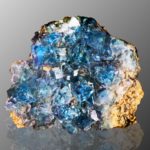
Turquoise and dyed howlite often look similar in jewelry listings, especially when both are blue with dark veining. However, genuine turquoise is a hydrous copper-aluminum phosphate, while howlite is a different calcium borosilicate mineral. Knowing which material a seller is offering matters more than judging a photograph.
Why dyed howlite is used as a turquoise imitation
Howlite is generally pale with gray veining and can absorb dyes, allowing manufacturers to create saturated blue beads that resemble turquoise. Dyeing howlite does not transform it chemically into turquoise. It can be perfectly suitable for affordable fashion jewelry when accurately described, but selling it as natural turquoise misrepresents the material and may distort the price.
Appearance and veining are not laboratory proof
Turquoise commonly ranges from blue to green and can contain matrix. Dyed howlite can have dark lines that appear convincing in photographs. Perfectly even dye, color concentrated near holes, or patches of original pale material may raise questions, but no one clue proves a stone is imitation. Natural turquoise can also be dyed, and photos often distort tones.
Understand treatments versus imitations
Stabilized turquoise remains turquoise that has been impregnated to improve durability. Dyed turquoise is another treated category. By contrast, dyed howlite is not turquoise at all. The invoice should distinguish natural untreated turquoise, stabilized turquoise, dyed turquoise, composite material and dyed howlite. For a seller, ‘genuine turquoise color’ is not an adequate identification.
Why scratch, flame and acetone tests are poor choices
Home guides sometimes recommend scratching a bead, rubbing with solvent or heating it to reveal a white interior. These actions can spoil jewelry, coatings and the finish on a genuinely valuable stone. A failed home experiment still cannot reliably establish mineral identity. Ask for documentation or consult a gemologist instead of performing destructive tests.
How a gemologist can identify the material
Gemological specialists may examine physical, optical and spectral properties to differentiate turquoise from howlite, magnesite and other look-alikes. Infrared spectroscopy is especially useful for detecting polymers and certain imitation materials. A laboratory report may be justified if the material is expensive or the seller’s claim affects its value.
What to request before buying
Ask for a clear name, known enhancements, photographs in neutral lighting, dimensions, return policy and any reliable laboratory evidence. Compare similar pieces with equivalent disclosure. Be cautious about a very low-priced large necklace advertised as rare untreated turquoise without explanation. Trustworthy sellers will explain uncertainties rather than guarantee identity from a phone image.
Buyer checklist
- Ask for the gemstone’s exact mineral identity and whether it is natural, laboratory-grown, or an imitation.
- Request known treatments and care restrictions in writing.
- Inspect photographs under neutral lighting and compare complete dimensions.
- Check whether a credible independent gemological report is appropriate to the price.
- Keep a receipt and understand the return policy before paying.
Frequently asked questions
Can photographs prove that a gemstone is natural?
No. Photographs can reveal appearance, not confidently establish mineral identity, growth origin or treatment history.
Do treatments always make gemstones fake?
No. Natural stones may be treated. Known treatments should be disclosed separately from natural origin.
Is a home scratch or chemical test recommended?
No. Such tests can damage gems and provide incomplete answers.
Related GemTycoon resources
Evidence and further reading
- Gemological Institute of America — relevant gemology guide or research
- GIA — How colored stones are analyzed
Educational content. Photographs and general comparisons are not laboratory identifications or appraisals.