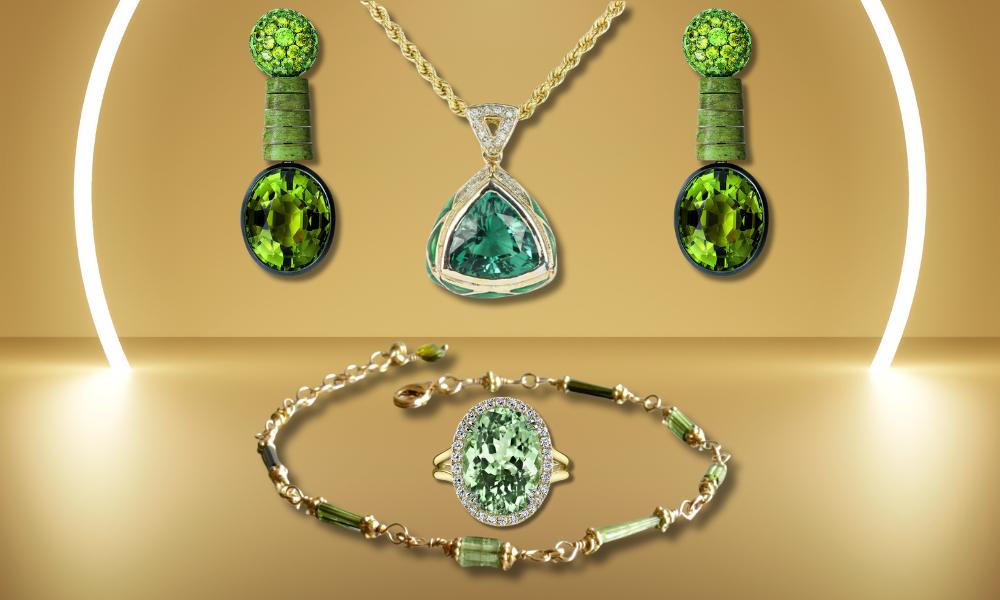
Emerald and green tourmaline can both make striking green jewelry, but they are distinct mineral groups with different optical characteristics and market considerations. Emerald is green to bluish-green beryl; green tourmaline belongs to the tourmaline mineral group. Neither stone can be authenticated by hue alone.
Mineral identity matters more than a shared color
Emerald is a variety of beryl, while green tourmaline describes green members of a separate group of borosilicate minerals. Their appearance can overlap, especially in photos of polished gems. It is incorrect to treat any intense green crystal as an emerald; a properly identified green tourmaline may be beautiful and valuable in its own right.
How color changes a buyer’s choice
GIA notes that emerald is prized for vivid green to bluish-green color with attractive transparency. Green tourmaline ranges from soft olive and yellowish green to saturated bluish-green, and some varieties exhibit strong pleochroism. Examine the same stone under different light sources and angles, because deep color can obscure brilliance.
Inclusions and clarity expectations differ
Emeralds commonly contain inclusions visible to the unaided eye; accepting some inclusions is normal within the market. Green tourmaline can also contain fluid-related inclusions, but expectations depend on its color and quality. In either stone, surface-reaching fractures can affect durability. Never assume a clean-looking photograph proves a gem is untreated or natural.
Hardness is only part of durability
Emerald commonly ranks about 7.5 to 8 on the Mohs scale; tourmaline generally rates about 7 to 7.5. The difference does not by itself predict breakage. Cleavage, internal fractures and the design of the mounting matter. Emeralds with surface-reaching fractures or filling deserve additional cleaning precautions, particularly in exposed rings.
Why treatment questions differ
Emeralds are frequently clarity enhanced using oils or resins in surface-reaching fissures. Some tourmaline may be heated or irradiated to alter its color. A seller should disclose known treatments separately from natural origin. Avoid steam and ultrasonic cleaning of fracture-filled emeralds; ask a jeweler for safe methods suitable to the specimen.
Price, quality and jewelry setting
Both gem types vary enormously in price according to color, cut, clarity, size, demand and treatment. Emerald can command strong premiums for fine specimens, but a large low-quality emerald is not automatically more valuable than exceptional tourmaline. Compare actual stones rather than species-wide slogans, and prioritize protective mountings for fragile or included gems.
Buyer checklist
- Ask for the gemstone’s exact mineral identity and whether it is natural, laboratory-grown, or an imitation.
- Request known treatments and care restrictions in writing.
- Inspect photographs under neutral lighting and compare complete dimensions.
- Check whether a credible independent gemological report is appropriate to the price.
- Keep a receipt and understand the return policy before paying.
Frequently asked questions
Can photographs prove that a gemstone is natural?
No. Photographs can reveal appearance, not confidently establish mineral identity, growth origin or treatment history.
Do treatments always make gemstones fake?
No. Natural stones may be treated. Known treatments should be disclosed separately from natural origin.
Is a home scratch or chemical test recommended?
No. Such tests can damage gems and provide incomplete answers.
Related GemTycoon resources
Evidence and further reading
- Gemological Institute of America — relevant gemology guide or research
- GIA — How colored stones are analyzed
Educational content. Photographs and general comparisons are not laboratory identifications or appraisals.